Starlight Ceiling in House: The Complete Guide to Costs, Installation, and Best Rooms in 2026
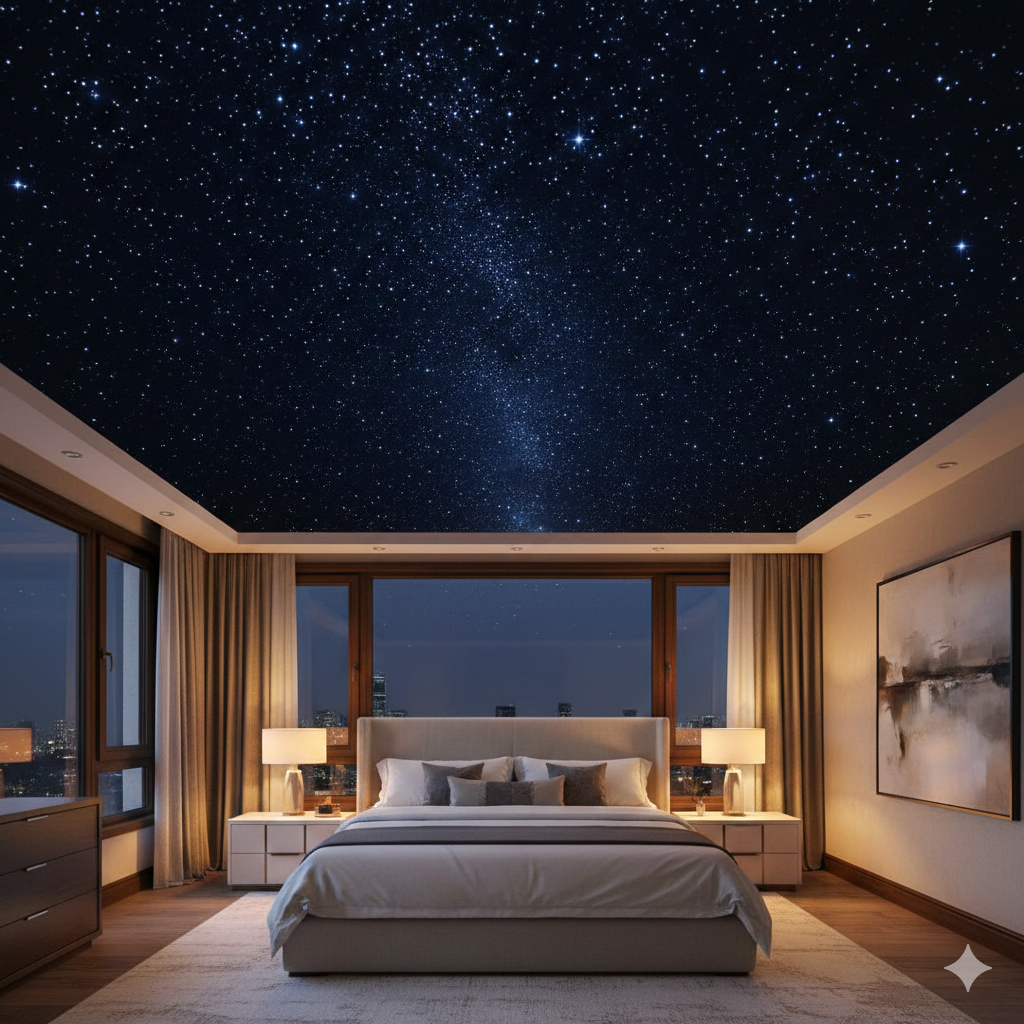
A starlight ceiling in your house transforms any ordinary room into a breathtaking personal planetarium. Fiber optic star ceilings use thousands of tiny light-transmitting strands paired with LED engines to create a realistic, twinkling night sky — right above your head. Typical residential installations cost between $3,000 and $15,000, last 20+ years, and use less electricity than a single light bulb.
Whether you're building a dream home theater, designing a magical nursery, or adding luxury to your master bedroom, a starlight ceiling is one of the most dramatic upgrades you can make. It's also one of the few home improvements that delivers both an emotional "wow factor" and measurable property value — homes with custom starlight ceilings report a 50–100% return on investment at resale.
In this guide, we'll break down exactly what a starlight ceiling costs in 2026, how installation works step-by-step, which rooms benefit most, and how to choose the right system for your home. As America's #1 starlight ceiling company, we've completed over 2,500 installations nationwide and know exactly what homeowners need to make the right decision.
✦ Quick Answer: Starlight Ceiling in House — Key Facts
A fiber optic starlight ceiling recreates a realistic night sky indoors using LED light engines and thousands of fiber optic strands threaded through your ceiling. Here are the essential numbers:
- Typical residential cost: $3,000–$15,000 depending on room size, star density, and customization
- DIY kit cost: $500–$2,000 (panels or basic kits for smaller projects)
- Energy usage: Only 5–15 watts (less than a single LED bulb)
- Lifespan: 20+ years with virtually zero maintenance
- Best rooms: Home theaters, master bedrooms, nurseries, bathrooms, and media rooms
- Installation time: 1–3 days for professional installation; weekends for DIY panels
- Home value impact: 50–100% ROI at resale as a luxury feature
What Is a Starlight Ceiling and How Does It Work?
A starlight ceiling (also called a star ceiling or fiber optic ceiling) is a lighting system that simulates a night sky filled with twinkling stars on the ceiling of any room. The system uses three core components: a fiber optic cable bundle, an LED light engine, and your ceiling surface itself.
Here's the simplified version: the LED light engine sits hidden above or beside the ceiling. It pushes light into hundreds or thousands of hair-thin fiber optic strands. Each strand is threaded through a tiny hole in the ceiling, and when light travels through the fiber, the tip glows like a real star. Advanced systems add twinkling effects, shooting star simulations, and RGB color changes — all controlled by remote or smartphone app.
Fiber Optic vs. LED Star Ceilings: What's the Difference?
Not all star ceilings are created equal. There are two main technologies, and understanding the difference will save you money and frustration:
| Feature | Fiber Optic Star Ceiling | LED Panel Star Ceiling |
|---|---|---|
| Realism | Extremely realistic — mimics actual starry sky | Good, but noticeably artificial up close |
| Twinkling Effect | Natural, randomized twinkling | Programmed patterns, less organic |
| Customization | Unlimited — custom constellations, density, placement | Limited to panel grid layout |
| Installation | Professional recommended (threading fibers) | Easier DIY (mount panels to ceiling) |
| Durability | 20–50+ years (fibers don't degrade) | 10–20 years (LED boards may need replacement) |
| Cost | $3,000–$15,000+ (professional install) | $500–$3,000 (panels/DIY kits) |
| Best For | Luxury homes, theaters, permanent installs | Budget projects, rentals, quick upgrades |
For the most authentic experience, fiber optic technology wins every time. It's what you'll find in high-end home theaters, luxury hotels, and professional starlight ceiling installations. LED panels work well for budget-conscious homeowners or renters who need something removable.
Pro Tip: Fiber optic strands carry no electricity and produce zero heat at the ceiling surface. This makes them completely safe for nurseries, children's rooms, and areas near insulation — a major advantage over any LED-based alternative.
How Much Does a Starlight Ceiling Cost in 2026?
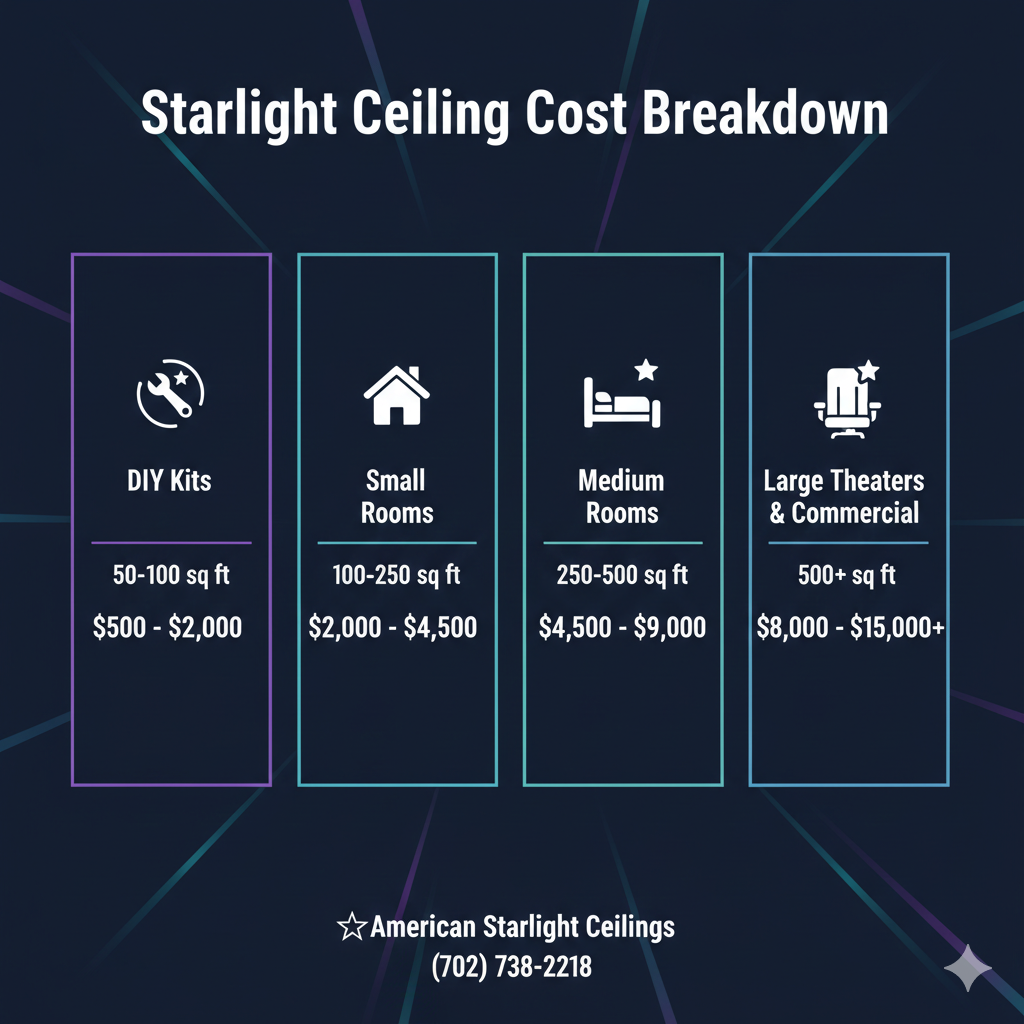
The cost of a starlight ceiling in your house depends on four main factors: room size, star density, system complexity, and whether you go DIY or professional. Here's a realistic breakdown based on current 2026 market pricing.
Starlight Ceiling Cost by Room Size
| Room Size | Star Count | DIY Kit Cost | Professional Install |
|---|---|---|---|
| Small (50–100 sq ft) — Bathroom, Nursery | 200–500 | $500–$1,200 | $2,000–$4,500 |
| Medium (100–250 sq ft) — Bedroom, Media Room | 500–1,500 | $1,000–$2,500 | $4,500–$9,000 |
| Large (250–500 sq ft) — Home Theater, Living Room | 1,500–3,000+ | $2,000–$4,000 | $8,000–$15,000 |
| Extra Large (500+ sq ft) — Commercial, Great Room | 3,000–10,000+ | N/A (professional recommended) | $15,000–$50,000+ |
What Affects the Price?
Star density is the biggest cost driver. A sparse sky with 3–4 stars per square foot looks subtle and elegant. A dense sky with 8–12 stars per square foot creates the immersive "Milky Way" effect most home theater owners want. More stars means more fiber, more drilling, and more labor.
System features also matter. A basic white-light twinkling system costs significantly less than an RGBW color-changing system with shooting star effects, constellation mapping, and Bluetooth control. Advanced systems add $1,000–$3,000 to the project.
Ceiling accessibility can make or break your budget. If there's attic access above the room, installation is straightforward. If the ceiling is inaccessible — like a concrete slab or finished room above — your installer may need to create drop-ceiling panels, which adds cost and reduces ceiling height slightly.
Custom constellations like Orion, the Big Dipper, or zodiac patterns require precise star mapping and fiber placement. This handcrafted detail is one of the features that makes professional fiber optic lighting worth the investment.
ROI and Home Value
Starlight ceilings consistently rank among the highest-ROI luxury home upgrades. Real estate agents report that well-installed starlight ceilings in home theaters and master suites generate 50–100% return on investment at resale. In luxury markets, a professionally installed star ceiling can push a home theater from "nice" to "must-have" in the eyes of buyers.
Cost-Saving Tip: If you're building a new home or remodeling, install the starlight ceiling before drywall goes up. This saves 30–40% on installation labor because fibers can be threaded from above without drilling individual holes through a finished ceiling.
How Is a Starlight Ceiling Installed? (Step-by-Step)
Professional starlight ceiling installation follows a proven 7-step process. Understanding each phase helps you prepare your space and set realistic timeline expectations.
Step 1: Design Consultation and Star Mapping
Every project starts with a plan. Your installer measures the ceiling, discusses star density preferences, identifies the light engine placement location, and creates a detailed star layout. If you want custom constellations, this is where astronomically accurate star positions get mapped to your exact ceiling dimensions.
Step 2: Ceiling Preparation
The ceiling surface is inspected for access points. Attic access above the room is ideal. If access is limited, the installer may create removable panels or use a drop-ceiling approach. For existing drywall ceilings with attic access above, the ceiling typically stays intact.
Step 3: Fiber Layout and Drilling
For drywall ceilings, tiny 1–2mm holes are drilled at each mapped star location. For panel systems, holes are pre-drilled into foam board or MDF panels before mounting. Each hole represents one star point — a 300 square foot home theater with 8 stars per square foot means 2,400 individual holes.
Step 4: Fiber Optic Threading
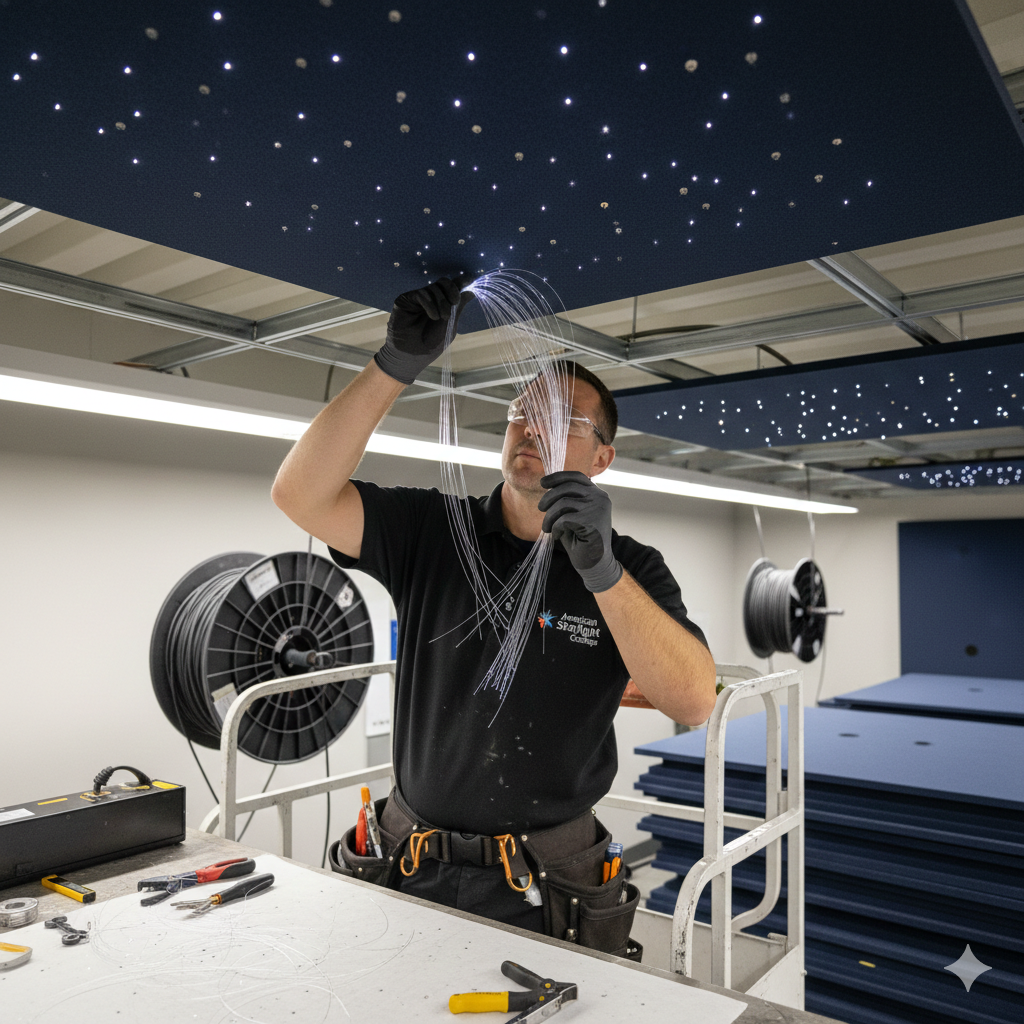
Individual fiber optic strands are threaded through each hole from above the ceiling. Different diameter fibers (0.5mm, 0.75mm, 1.0mm, 1.5mm) create natural-looking variation in star brightness — just like the real night sky where some stars are bright and others are faint.
Step 5: Light Engine Installation
The LED light engine is mounted in an accessible location above the ceiling, in a closet, or in an AV cabinet. All fiber strands are bundled and connected to the engine's output port. Advanced engines include twinkling wheels, RGBW color mixing, and wireless control modules.
Step 6: Finishing and Trimming
Once fibers are connected and tested, each strand is trimmed flush with the ceiling surface. A tiny dot of clear adhesive secures each fiber in place. The result is virtually invisible during daylight — the stars only appear when activated.
Step 7: Testing and Programming
The system is powered on, twinkling speed is adjusted, color programs are configured, and the homeowner receives full training on controls. Shooting star effects, color cycling, brightness levels, and timer schedules are all programmed to your preferences.
Best Rooms in Your House for a Starlight Ceiling
While you can install a starlight ceiling in any room, certain spaces deliver dramatically better results. Here's where our 2,500+ completed projects tell us starlight ceilings make the biggest impact.
Home Theaters and Media Rooms
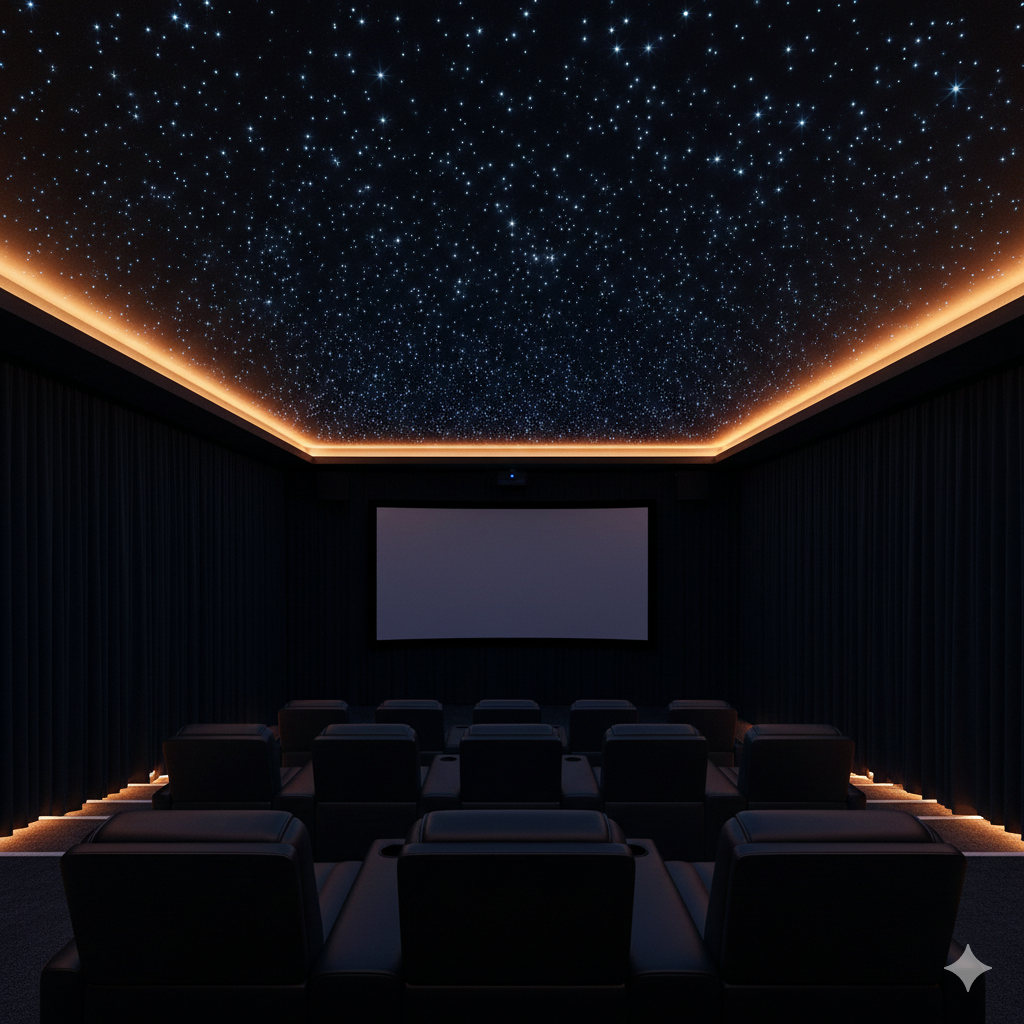
This is the #1 most popular room for a starlight ceiling — and for good reason. A star-filled sky above your home theater creates an immersive cinema experience that no other upgrade can match. The fiber optic stars produce zero screen glare or light pollution, meaning they can stay on during movies. Combined with a dark ceiling and cove lighting, the effect is breathtaking.
Most home theater starlight ceilings use 6–10 stars per square foot for a dense, immersive field. Acoustic fiber optic panels serve double duty by providing both the star effect and sound absorption for better audio quality. This is where professional starlight ceiling installations truly shine.
Master Bedrooms
A starlight ceiling turns your master bedroom into a romantic retreat. Drifting off to sleep under a twinkling sky is one of those experiences that sounds extravagant until you actually try it — then it becomes something you can't imagine living without. Bedrooms typically use a lower star density (3–5 stars per square foot) for a calming, subtle effect.
Nurseries and Children's Rooms
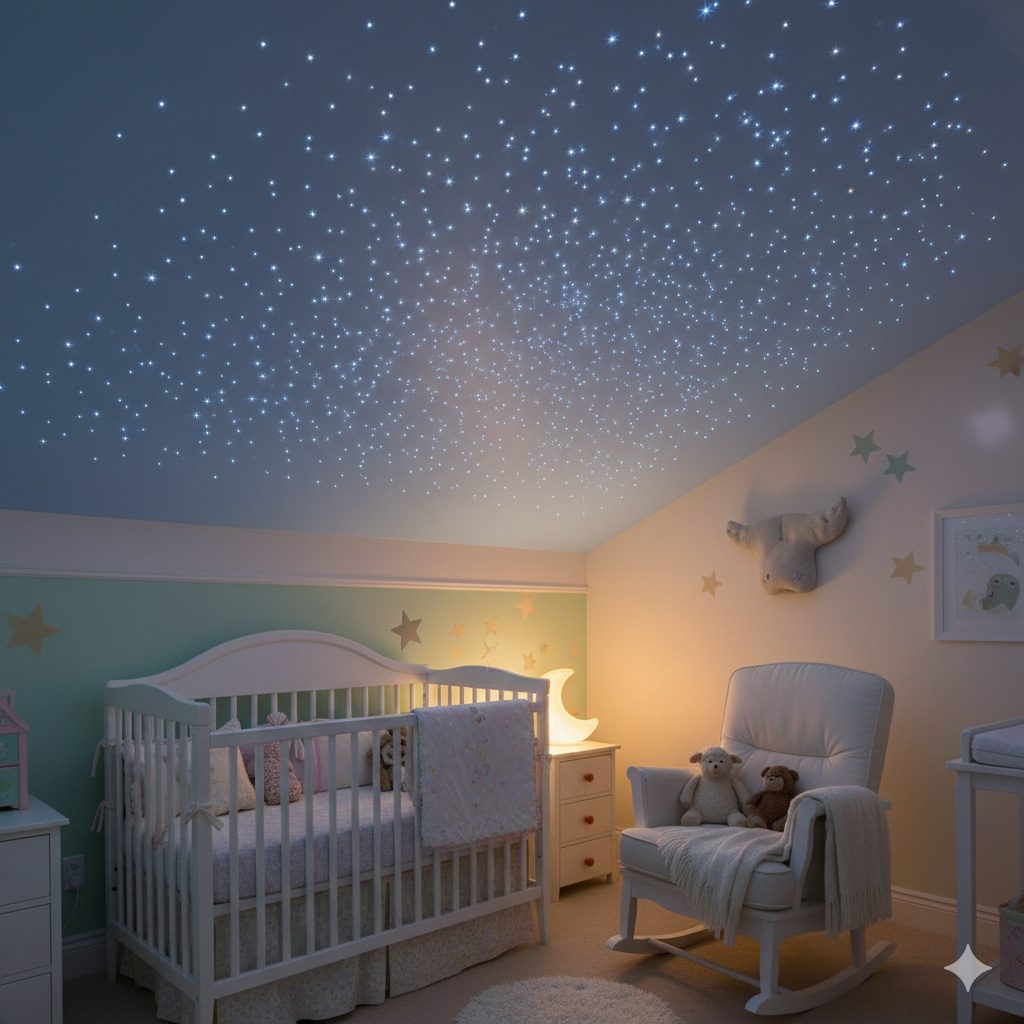
Parents consistently tell us that a starlight ceiling in the nursery transforms bedtime. Children fall asleep faster, wake less frequently, and associate their room with wonder rather than darkness. Because fiber optics carry no electricity at the ceiling surface and produce zero heat, they're completely safe for nurseries and children's rooms.
Bathrooms and Spa Spaces
Luxury bathrooms are increasingly incorporating starlight ceilings, especially above freestanding bathtubs and walk-in showers. The stars create a spa-like atmosphere for daily relaxation. For water-adjacent areas, consider pairing your starlight ceiling with premium pool and aquatic lighting for a fully integrated wellness space.
Living Rooms and Great Rooms
In open-concept homes, a starlight ceiling in the main living area makes a stunning architectural statement. These larger installations often incorporate custom constellation patterns, Milky Way bands, and color-changing effects as the centerpiece of the entire home.
Design Tip: For the most realistic effect, pair your starlight ceiling with a dark (navy, charcoal, or black) ceiling paint. The darker the background, the more the fiber optic stars pop. Some homeowners add a painted nebula or Milky Way mural behind the fibers for an ultra-realistic night sky effect.
DIY Star Ceiling Panels vs. Professional Fiber Optic Installation
One of the most common decisions homeowners face is whether to tackle a star ceiling as a DIY project or hire professionals. Both paths can deliver excellent results — but they serve different needs.
When DIY Star Ceiling Panels Make Sense
Pre-made star ceiling panels are a practical option for homeowners who want the effect without a major project. Modern plug-and-play panels come pre-wired with fiber optics already installed in acoustic tiles. You mount them to the ceiling, connect the daisy-chain wiring, and plug in. Total installation time: a few hours.
DIY panels are best for budget-conscious projects under $3,000, renters who need a non-permanent solution, smaller spaces like bathrooms or offices, and homeowners comfortable with basic tools and ceiling work.
The trade-off is customization. Panels come in fixed sizes (typically 2'x2' or 4'x4'), fixed star patterns, and limited density options. You won't get custom constellations, variable star sizes, or that seamless edge-to-edge sky look.
When Professional Installation Is Worth It
For home theaters, master bedrooms, and large-scale installations, professional installation delivers a result that DIY simply can't match. A professional installer maps individual star positions, uses multiple fiber diameters for realistic brightness variation, creates seamless coverage with no visible panel edges, and programs advanced effects.
The result is the difference between "cool lighting" and "it looks like real stars." If you're investing in a space you'll use for decades, professional installation from an experienced starlight ceiling company is the way to go.
| Factor | DIY Panels | Professional Install |
|---|---|---|
| Cost | $500–$3,000 | $3,000–$15,000+ |
| Realism | Good (visible panel edges possible) | Exceptional (seamless, natural variation) |
| Custom Constellations | No | Yes — astronomically accurate |
| Installation Time | 2–6 hours | 1–3 days |
| Acoustic Benefit | Yes (panels double as acoustic tiles) | Depends on ceiling type |
| Permanence | Removable | Permanent (adds to home value) |
| Shooting Stars / Effects | Limited | Full range (RGB, shooting stars, meteor showers) |
Starlight Ceiling Maintenance: What to Expect
One of the best things about fiber optic starlight ceilings is how little maintenance they require. Here's the honest truth about long-term ownership.
LED light engines are rated for 50,000+ hours of operation. Running your starlight ceiling 6 hours every night, that's over 22 years before you'd need to replace the engine — and replacement is simple since the engine is mounted in an accessible location.
Fiber optic strands themselves are virtually indestructible under normal conditions. PMMA (acrylic) fibers don't degrade from light exposure, don't corrode, and don't conduct electricity. The only maintenance is occasional ceiling dusting, which you'd do anyway.
Energy consumption is negligible. A typical residential starlight ceiling system draws only 5–15 watts — less than a single LED light bulb. Your annual electricity cost for running a star ceiling nightly is roughly $2–$5 per year.
How to Choose the Right Star Ceiling System for Your Home
With dozens of products on the market, choosing the right starlight ceiling system can feel overwhelming. Focus on these five factors to make the right decision.
1. Light Engine Quality
The LED light engine is the heart of your system. Look for engines with high-output LEDs (16W minimum for medium rooms), built-in twinkling wheels for natural star effects, RGBW capability if you want color options, and wireless control (RF remote or Bluetooth/WiFi app). Cheap engines produce dim, flat light with no twinkling — and they fail faster.
2. Fiber Type and Diameter Mix
The most realistic star ceilings use a mix of fiber diameters: 0.5mm (faint background stars), 0.75mm (medium stars), 1.0mm (bright stars), and 1.5mm (major constellation stars). Single-diameter systems look uniform and artificial. A proper mix creates the depth and variation you see in a real night sky.
3. Star Density
For home theaters and immersive spaces, we recommend 6–10 stars per square foot. For bedrooms and relaxation spaces, 3–5 stars per square foot creates a calmer feel. For accent ceilings and partial coverage, 2–3 stars per square foot provides subtle elegance.
4. Ceiling Access and Construction
If you have attic access above the room, you have the most options and lowest installation cost. If you're working with a finished ceiling and no access above, star ceiling panels or a drop-ceiling approach is the way to go. During new construction or remodeling, starlight ceilings should be planned before drywall goes up.
5. Professional vs. DIY
Be honest about your skill level and expectations. DIY kits and panels work great for simple projects. For anything over 200 square feet, involving custom constellations, or requiring seamless coverage, invest in professional installation. The difference in the final result is dramatic.
Want help choosing? Call us at (702) 738-2218 for a free consultation. We'll walk you through options based on your room size, ceiling type, budget, and design vision — no pressure, no obligation.
Starlight Ceilings for Commercial Spaces
While this guide focuses on residential starlight ceilings, it's worth mentioning that businesses are increasingly using star ceilings to create unforgettable customer experiences. Restaurants, bars, nightclubs, hotels, spas, casinos, and corporate lobbies all benefit from the dramatic ambiance.
For commercial projects in Texas, our network provides comprehensive lighting solutions. From LED lighting solutions in Dallas to Fort Worth LED lighting, LED lighting in Plano, commercial LED lighting in Arlington, and Irving LED lighting services, we handle everything from starlight ceiling installations to full commercial LED retrofits.
Businesses across the state rely on our Texas-wide LED lighting expertise and wholesale LED solutions for projects of every scale. For businesses exploring unique building solutions that incorporate lighting design from the ground up, our partners at America Modular Buildings and Dallas Modular Structures integrate starlight ceilings into modular building projects.
Frequently Asked Questions About Starlight Ceilings
How much does a starlight ceiling cost for a house?
A residential starlight ceiling typically costs between $3,000 and $15,000 for professional installation, depending on room size, star density, and system features. DIY star ceiling panel kits start at $500 for small rooms. A standard 200 sq ft bedroom installation averages $5,000–$8,000, while a 350 sq ft home theater with high star density and RGB effects runs $10,000–$15,000.
Are starlight ceilings worth it?
Yes. Starlight ceilings deliver a 50–100% return on investment at resale, last 20+ years with virtually zero maintenance, use only 5–15 watts of electricity (less than $5/year to operate), and create dramatic ambiance that transforms how a room looks and feels. They're particularly valuable in home theaters, master bedrooms, and luxury bathrooms.
How long does a starlight ceiling installation take?
Professional fiber optic starlight ceiling installation takes 1–3 days for most residential rooms. Small rooms (bathrooms, nurseries) can be completed in a single day. Large home theaters with high star density may take 2–3 days. DIY star ceiling panels can be installed in 2–6 hours since they come pre-wired.
Can I install a starlight ceiling myself?
Yes, with the right product. Pre-made star ceiling panels are designed for DIY installation — they mount directly to the ceiling with basic tools and connect via plug-and-play wiring. For custom fiber optic installations requiring individual strand threading, professional installation is strongly recommended unless you have construction experience and above-ceiling access.
Do starlight ceilings use a lot of electricity?
No. Fiber optic starlight ceilings are extremely energy efficient. A typical residential system draws only 5–15 watts total — less than a single LED light bulb. Running the system 6 hours every night costs roughly $2–$5 per year in electricity. The LED engines are rated for 50,000+ hours of operation.
What is the best room for a starlight ceiling?
Home theaters are the #1 most popular room for starlight ceilings because the stars create an immersive cinema experience without screen glare. Master bedrooms are second, offering a romantic retreat for falling asleep under the stars. Nurseries, bathrooms, media rooms, and living rooms are also excellent choices.
How long do fiber optic star ceilings last?
Fiber optic strands are rated to last 50+ years under normal residential conditions. The LED light engine is the component with a finite lifespan, rated for 50,000+ hours — that's over 22 years at 6 hours of nightly use. Replacement engines are inexpensive and easy to swap since they're mounted in accessible locations.
Can starlight ceilings change colors?
Yes, if you choose an RGBW (Red, Green, Blue, White) light engine. Advanced systems let you cycle through millions of colors, program color transitions, set specific moods (warm white, cool blue, aurora effects), and control everything from a smartphone app or RF remote. Basic systems offer white-only twinkling, which many homeowners prefer for realism.
Are starlight ceilings safe for nurseries and kids' rooms?
Absolutely. Fiber optic star ceilings are one of the safest lighting options for children's rooms. The fiber strands carry light only — no electricity reaches the ceiling surface. They produce zero heat, emit no UV radiation, and have no accessible electrical components in the room. The low-light twinkling effect also helps children fall asleep faster.
Do starlight ceilings add value to a home?
Yes. Professionally installed starlight ceilings are a luxury feature that adds measurable resale value. In home theaters and master suites, real estate agents report a 50–100% ROI. They're particularly valuable in luxury markets where buyers expect unique, high-end finishes. A well-done starlight ceiling can be the feature that sells a home.
Ready to Transform Your Ceiling Into a Starry Sky?
Get a free, no-obligation quote for your starlight ceiling project. Whether it's a cozy nursery or an epic home theater, we'll design the perfect installation for your space and budget. Serving homeowners in all 50 states.
(702) 738-2218 Get Your Free Quote →