Fiber Optic Star Ceiling Installation Near Me: How to Find the Right Installer in 2026
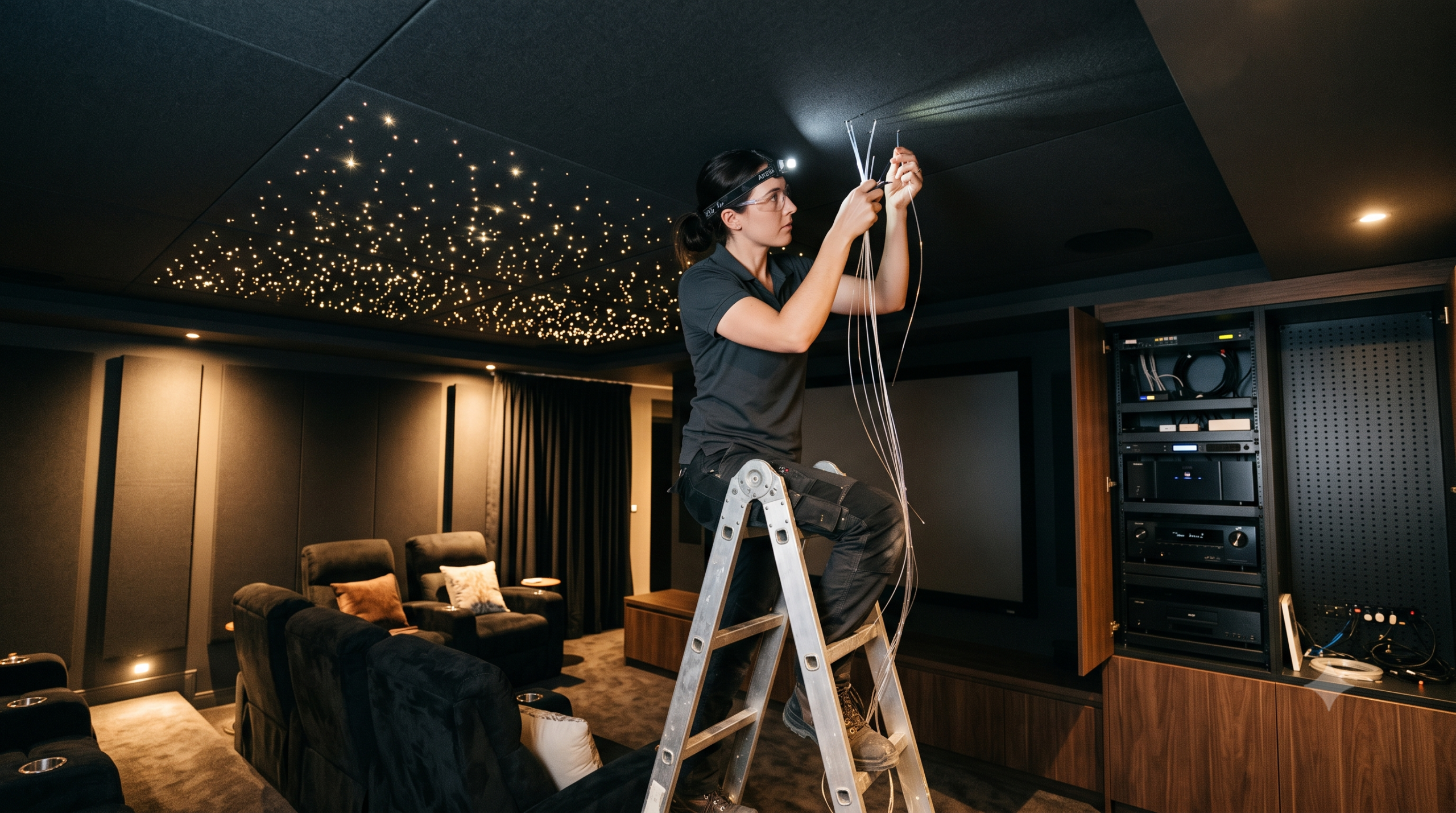
Searching for fiber optic star ceiling installation near me? You're not alone — and you've probably noticed that most results are for car headliners, not residential or commercial ceiling installations. Finding a qualified starlight ceiling installer for your home theater, bedroom, or business is a completely different search than finding an automotive shop. The skills, materials, and scale are worlds apart.
Here's the good news: professional starlight ceiling installation is available nationwide, and the right installer can transform any room in your house into a breathtaking night sky. The key is knowing what to look for, what questions to ask, and what to expect from the process. A quality professional starlight ceiling installation lasts 20+ years and delivers results that DIY kits simply can't match.
In this guide, we'll walk you through exactly how to find a starlight ceiling installer near you, what the installation process looks like from first call to final star, how much it costs, and the critical red flags to avoid. Whether you're in Dallas, Los Angeles, Miami, New York, or anywhere in between, this is the definitive resource for getting your star ceiling project done right.
✦ Quick Answer: Finding Star Ceiling Installation Near You
Unlike car headliner shops on every corner, residential fiber optic star ceiling installers are a specialty trade. Most homeowners work with a nationwide company that travels to their location rather than searching for a local shop. Here's what you need to know:
- Nationwide installers are the norm — most star ceiling companies travel to your location and include travel in the project quote
- Cost range: $3,000–$15,000 for residential rooms; $15,000–$50,000+ for commercial spaces
- Timeline: 2–4 weeks from consultation to installation; 1–3 days on-site for most rooms
- Key qualification: Look for fiber optic experience (not just LED), a portfolio of completed residential projects, and a workmanship warranty
- Free consultations are standard — never pay for a quote from a reputable installer
- Avoid: Installers with only car headliner experience, companies with no portfolio, and anyone who can't explain the difference between fiber optic and LED star ceilings
Why "Star Ceiling Installation Near Me" Is Hard to Search For
If you've already Googled "starlight ceiling installation near me," you know the frustration. The search results are flooded with automotive headliner installers, cheap LED projectors on Amazon, and glow-in-the-dark sticker kits. Almost none of the results are for what you actually want: a professional fiber optic star ceiling installed in your home or business.
There's a reason for this. Residential and commercial starlight ceiling installation is a highly specialized trade with a relatively small number of qualified professionals nationwide. Unlike plumbing or electrical work, there's no licensing category for "starlight ceiling installer." That means you won't find them in the Yellow Pages or on most contractor directories.
The reality is that most professional star ceiling installations are handled by specialty companies that operate nationwide, not by local handymen or general contractors. These companies have dedicated teams that travel to your location — whether that's a luxury home in Scottsdale, a restaurant in Chicago, or a home theater in Atlanta. The travel and logistics are built into the project quote, so you're getting the same quality installation regardless of where you live.
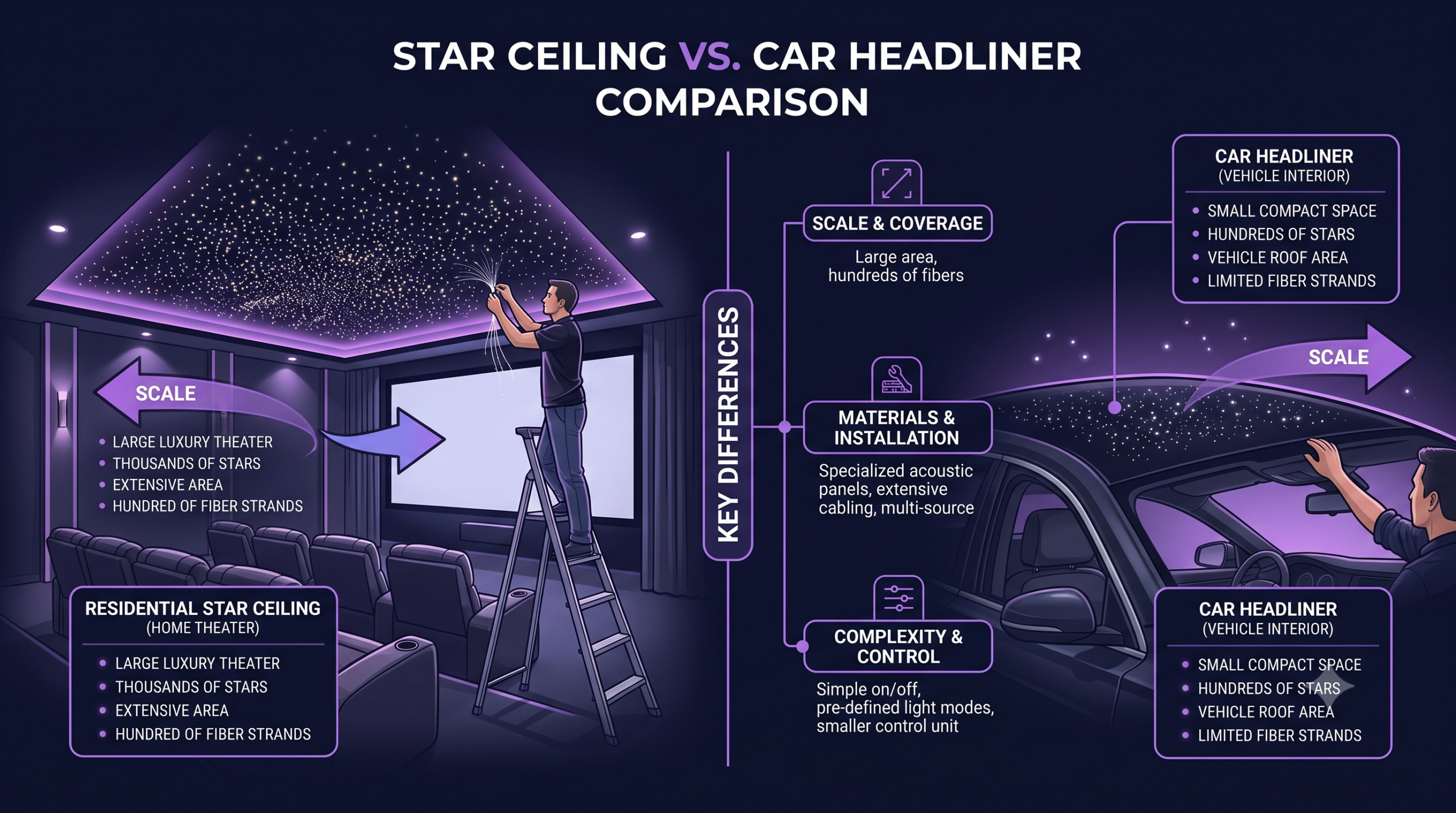
Important distinction: A car starlight headliner installation involves gluing fiber optics into a removable fabric panel in a vehicle. A home starlight ceiling installation involves threading thousands of fiber strands through drywall, foam panels, or acoustic tiles in a permanent ceiling structure. The materials, techniques, scale, and expertise are completely different. Don't hire an automotive shop for your home project.
What to Look for in a Starlight Ceiling Installer
Not all installers are created equal. Whether you find a company through Google, a referral, or social media, here's exactly what to evaluate before signing a contract.
1. Fiber Optic Experience (Not Just LED)
The most common mistake homeowners make is hiring someone who works with LED strips or LED star projectors — not actual fiber optics. True fiber optic star ceilings use fiber optic lighting technology where light travels through hair-thin strands from a remote light engine. LED-based "star ceilings" are a different product entirely. Ask your installer: "Do you use fiber optic cable with a separate LED light engine, or are the LEDs mounted directly in the ceiling?" The right answer is fiber optic cable with a remote engine.
2. A Portfolio of Completed Residential Projects
Demand to see photos and videos of finished installations — in homes, not in cars. Look for projects similar to yours: home theaters, bedrooms, nurseries, or commercial venues. Pay attention to star density, evenness of distribution, fiber trimming quality, and the overall "wow factor." A quality portfolio shows consistency across multiple projects.
3. Knowledge of Multiple Ceiling Types
Your installer should be able to confidently discuss installation methods for drywall ceilings with attic access, drywall with no access above, drop ceilings, acoustic panel systems, vaulted and sloped ceilings, and stretch ceilings. If they only know one method, they may not be equipped for your specific ceiling situation.
4. Workmanship Warranty
A reputable installer offers a warranty on their work — not just on the product. The fiber optic materials themselves last 20–50 years, but the quality of installation determines whether your star ceiling looks perfect for decades or develops issues in the first year. Look for a minimum 2-year workmanship warranty in addition to the product warranty.
5. Transparent Pricing
You should receive a detailed written quote that breaks out product costs, installation labor, and any travel expenses. Be wary of vague "it depends" pricing without a formal estimate. For a comprehensive breakdown of what to expect, see our complete starlight ceiling cost guide.
Red Flags to Watch For
| Red Flag | Why It Matters |
|---|---|
| No portfolio or only car headliner photos | Residential ceilings require fundamentally different skills than automotive headliners |
| "We use LED strips, not fiber optics" | LED strips don't produce realistic star effects and degrade faster |
| No written warranty | If they won't stand behind the work, expect problems |
| Unusually low pricing (under $1,500 for a room) | Likely using cheap components that yellow and fail within 1–3 years |
| Can't explain the difference between fiber types | A qualified installer knows 0.5mm, 0.75mm, 1.0mm, and 1.5mm fibers and uses a mix for realism |
| No site assessment or consultation | Every ceiling is different — quoting without assessing the space is a shortcut |
| Demands large upfront deposit (over 50%) | Industry standard is 25–50% deposit with balance due at completion |
How to Find a Starlight Ceiling Installer Near You
Here are the most effective ways to find a qualified fiber optic star ceiling installer, ranked by reliability.
Option 1: Work with a Nationwide Specialty Company (Recommended)
The most reliable path is working with a company that specializes exclusively in starlight ceilings and serves clients nationwide. These companies have dedicated installation teams, established processes, proven portfolios, and the volume of experience that ensures consistent results. American Starlight Ceilings serves all 50 states with professional installation teams and has completed over 2,500 installations across residential, commercial, and marine applications.
The advantage of a nationwide specialist: you're getting a team that installs star ceilings every week, not a general contractor who's attempting their first one on your ceiling. The travel logistics are handled as part of the project, and you get the same quality whether you're in a major city or a rural area. View our nationwide service locations to find coverage in your area.
Option 2: Ask Your Home Theater or AV Installer
If you're building a dedicated home theater, your AV integrator may have relationships with star ceiling specialists. Companies that install projection screens, acoustic treatments, and cinema seating often partner with fiber optic ceiling professionals. This is especially useful if you want a single project manager coordinating the entire theater build.
Option 3: Contact Your General Contractor
If you're in the middle of a new home build or renovation, your GC can subcontract the starlight ceiling work. However, make sure the subcontractor they bring in has actual fiber optic star ceiling experience — not just general electrical or drywall skills. Provide your GC with the qualifications checklist above.
Option 4: Search Specialty Forums and Communities
Home theater forums like AVS Forum and Home Theater Forum have active communities where homeowners share their star ceiling projects and recommend installers. These peer reviews are often more reliable than Google reviews because the community members are knowledgeable and critical.
Skip these searches: Avoid searching for "starlight headliner installer" (that's for cars), "star projector installation" (that's a $30 Amazon gadget), and "glow in the dark ceiling" (that's paint or stickers). The right search terms are: "fiber optic star ceiling installation," "starlight ceiling installer," or "star ceiling company."
Starlight Ceiling Installation: Cities We Serve Nationwide
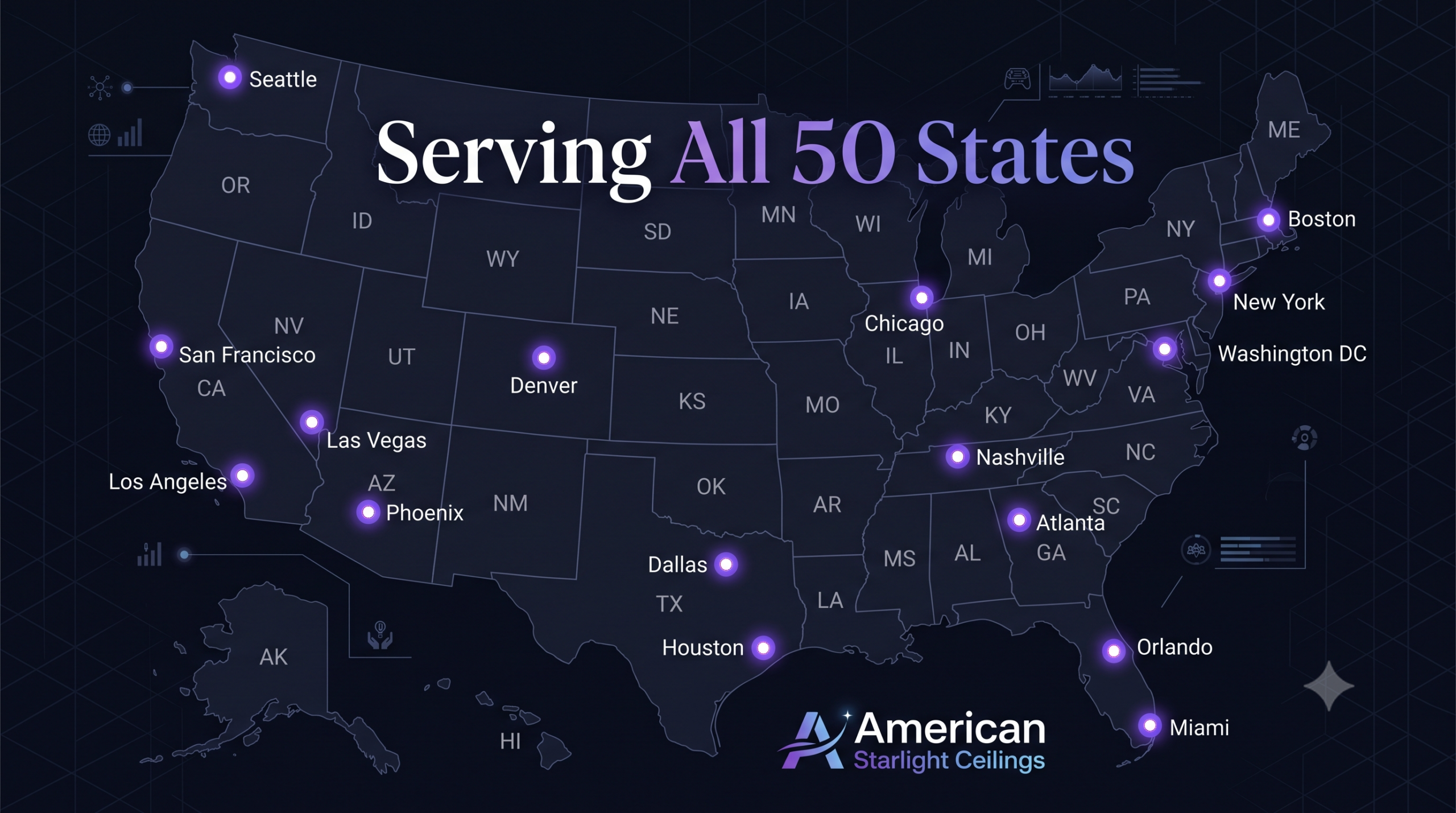
American Starlight Ceilings provides professional fiber optic star ceiling installation across all 50 states. Our most active installation markets include:
Don't see your city? We serve every state and most metropolitan areas. Contact us for a free consultation regardless of your location — our team coordinates installations across all time zones.
In the Texas and DFW market specifically, our installation teams work alongside our broader lighting network including Dallas LED lighting, Fort Worth LED lighting, Plano LED lighting, Arlington LED lighting, and Irving LED lighting services — delivering comprehensive residential and commercial lighting solutions from a single trusted source.
What to Expect: The Installation Process from First Call to Final Star
Once you've found your installer, here's exactly what the project timeline looks like from start to finish.
Free Consultation (Day 1)
You'll discuss your vision, room dimensions, ceiling type, star density preferences, color options, and budget. A good installer will ask about attic access, ceiling height, recessed light locations, HVAC registers, sprinkler heads, and how you plan to control the system. This call typically takes 20–30 minutes.
Site Assessment & Design (Week 1)
For complex projects, the installer may request photos, measurements, or a reflected ceiling plan showing all existing penetrations. Some companies offer virtual site assessments via video call. The design phase maps your custom star layout, determines fiber quantities and diameters, and identifies the optimal light engine location.
Formal Quote & Contract (Week 1–2)
You'll receive a detailed written quote covering product costs (panels, fibers, light engine, controls), installation labor, and any travel expenses. Review the scope carefully — make sure it specifies star count, fiber diameter mix, ceiling coverage area, control method, and warranty terms. A deposit (typically 25–50%) secures your installation date.
Fabrication & Preparation (Weeks 2–4)
Your custom panels or fiber bundles are fabricated to spec. If you're using pre-threaded acoustic panels, they're built in the shop with fibers already installed. For direct-to-drywall installations, fiber bundles are cut to length and organized for on-site threading. Materials are shipped or transported to your location.
On-Site Installation (1–3 Days)
The installation team arrives, preps the space, and installs the system. For panel systems, this involves mounting panels to the ceiling and connecting the light engine. For threaded systems, it means drilling thousands of tiny holes, threading individual fibers, connecting to the engine, and trimming each star flush. A typical bedroom takes 1 day; a home theater takes 2–3 days.
Testing, Programming & Handoff (Final Day)
Every star is tested, twinkling effects are calibrated, colors are programmed, and controls are configured. You'll receive training on operating the system — dimming, color changes, twinkling speed, shooting star effects (if applicable), and timer schedules. The final balance is due at this point.
Looking for a Starlight Ceiling Installer?
Skip the search headaches. American Starlight Ceilings serves all 50 states with professional installation teams, 2,500+ completed projects, and a lifetime workmanship warranty. Free consultations, no obligation.
(702) 738-2218 Get Your Free Quote →How Much Does Professional Star Ceiling Installation Cost?
Installation costs depend on your room size, ceiling type, star density, system features, and your location. Here's a realistic breakdown for 2026.
| Project Type | Typical Size | Cost Range | Timeline |
|---|---|---|---|
| Small Room (bathroom, nursery, closet) | 50–100 sq ft | $2,000–$5,000 | 1 day |
| Medium Room (bedroom, office, media room) | 100–250 sq ft | $5,000–$10,000 | 1–2 days |
| Home Theater (dedicated theater room) | 200–500 sq ft | $8,000–$20,000 | 2–3 days |
| Large Residential (great room, multi-room) | 500+ sq ft | $15,000–$35,000+ | 3–5 days |
| Commercial (restaurant, hotel, spa, casino) | 500–5,000+ sq ft | $15,000–$100,000+ | 1–3 weeks |
These prices include materials, installation labor, programming, and warranty. Travel costs for out-of-area installations are typically absorbed into the project quote or added as a flat fee — most reputable companies don't nickel-and-dime you on travel.
For budget-conscious homeowners, DIY starlight ceiling kits start at $500 and include everything you need for a smaller project. You can also explore our complete guide to starlight ceilings in your house for a full cost breakdown by room type.
Price tip: The biggest variable isn't room size — it's star density. A bedroom at 3 stars per square foot costs significantly less than a home theater at 10 stars per square foot, even if the rooms are the same size. More stars = more fiber = more labor = higher cost. Discuss density options with your installer to find the sweet spot between visual impact and budget.
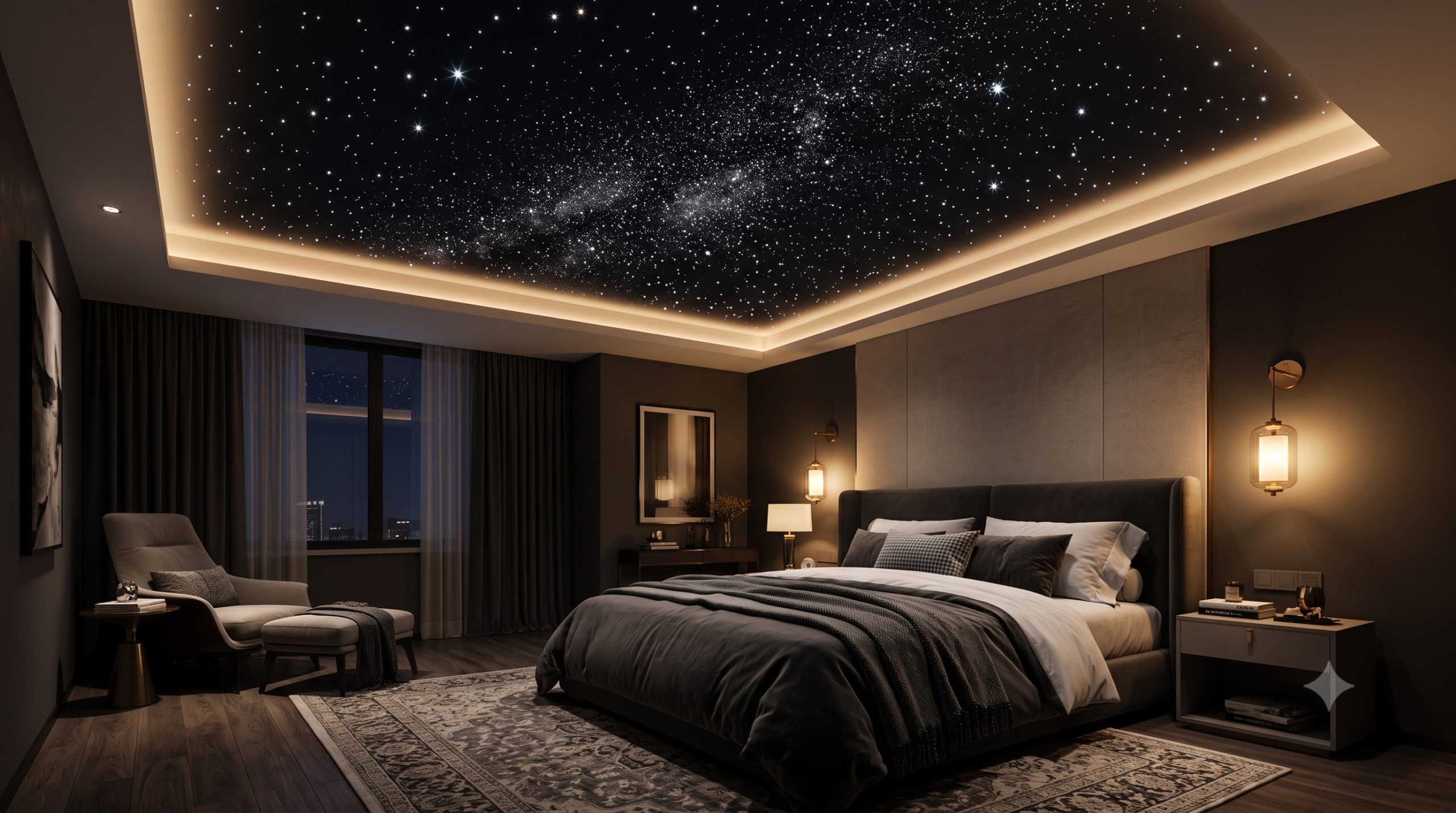
Should You DIY or Hire a Professional Installer?
It's a fair question. With DIY kits available from $500, why spend $5,000+ on professional installation? Here's the honest breakdown.
DIY Makes Sense When:
You're working with a small space (under 100 sq ft), you have attic access above the ceiling, your budget is under $2,000, you're comfortable with basic tools and ladder work, and you're okay with a good-but-not-perfect result. Pre-made star ceiling panels with pre-threaded fibers are genuinely DIY-friendly for handy homeowners.
Professional Installation Is Worth It When:
You're doing a home theater or large room (200+ sq ft), you want custom constellations or specific star patterns, you need seamless edge-to-edge coverage with no visible panel seams, you're integrating with a smart home system like Control4, Crestron, or Savant, or the ceiling has no attic access and requires panel fabrication. The difference in the finished result between DIY and professional work is substantial — professional installations use multiple fiber diameters for realistic star variation, precise star mapping, and invisible hardware.
For a deeper comparison, our residential starlight ceiling page covers both options in detail with pricing and project examples.
Commercial Star Ceiling Installation
Businesses searching for star ceiling installation face an even narrower field of qualified installers. Commercial projects involve larger scales, fire code compliance, acoustic requirements, integration with existing building systems, and coordination with general contractors and other trades.
Common commercial starlight ceiling applications include restaurants and bars (the starry ambiance drives social media shares and repeat visits), hotel lobbies and suites (luxury differentiation in competitive hospitality markets), spas and wellness centers (therapeutic atmosphere that enhances treatment experiences), casinos and entertainment venues (immersive environments that keep guests engaged), healthcare facilities (calming environments proven to reduce patient anxiety), and corporate offices (creative workspaces that attract talent).
Our commercial installation network extends across Texas-wide LED lighting services and wholesale LED solutions, with the infrastructure to handle projects of any scale. For businesses exploring ground-up construction with integrated lighting design, America Modular Buildings and Dallas Modular Structures offer modular building solutions with starlight ceilings designed in from day one.
Commercial clients can also incorporate premium pool and aquatic lighting for hospitality venues with water features, creating a fully integrated lighting experience across indoor and outdoor spaces.
Frequently Asked Questions About Star Ceiling Installation
How do I find a fiber optic star ceiling installer near me?
The most reliable approach is contacting a nationwide specialty company like American Starlight Ceilings that travels to your location. Unlike local trades, starlight ceiling installation is a specialty service with a limited number of qualified professionals. Most projects are handled by dedicated teams that serve clients in all 50 states. Call (702) 738-2218 for a free consultation.
Is a car headliner installer the same as a home ceiling installer?
No. Car starlight headliner installation involves embedding fiber optics into a removable fabric panel inside a vehicle. Home starlight ceiling installation involves threading thousands of fiber strands through permanent drywall, acoustic panels, or foam board in a building ceiling. The materials, tools, techniques, scale, and expertise are completely different. Never hire an automotive shop for a residential ceiling project.
How long does starlight ceiling installation take?
On-site installation typically takes 1–3 days for residential projects. A small bathroom or nursery can be completed in a single day. A medium bedroom takes 1–2 days. A full home theater with high star density and custom effects takes 2–3 days. The total project timeline from first consultation to completed installation is usually 2–4 weeks, with most of that time spent on design, fabrication, and scheduling.
Do star ceiling installers travel to my location?
Yes. Most professional starlight ceiling companies operate nationwide and travel to your location as a standard part of the service. Travel logistics and costs are typically included in the project quote or added as a flat fee. You should not need to find a local installer — the specialty nature of the work means nationwide companies deliver more consistent results than local generalists attempting their first star ceiling.
How much does star ceiling installation cost near me?
Residential starlight ceiling installation ranges from $2,000–$5,000 for small rooms (bathrooms, nurseries), $5,000–$10,000 for bedrooms and media rooms, and $8,000–$20,000 for home theaters. Commercial installations range from $15,000 to $100,000+ depending on scale. Prices include materials, installation labor, programming, and warranty. Location affects pricing slightly due to travel costs, but the main cost drivers are room size and star density.
What should I have ready before the installer arrives?
Clear the room of furniture and fragile items. Know your ceiling type (drywall, drop ceiling, concrete) and whether there's attic access above. Have a reflected ceiling plan or measurements showing the locations of recessed lights, HVAC vents, speakers, sprinkler heads, and any other ceiling penetrations. Decide where you want the LED light engine concealed (closet, attic, AV cabinet). Have a 120V outlet available near the engine location.
Can a general contractor install a starlight ceiling?
A GC can manage the project and subcontract the fiber optic work, but the actual fiber threading and light engine installation should be done by someone with specific star ceiling experience. General contractors excel at framing, drywall, and electrical — but the precision of threading 2,000+ individual fiber strands, mixing fiber diameters for realistic variation, and calibrating twinkling effects requires specialized training.
What warranty should I expect from a star ceiling installer?
Look for a minimum 2-year workmanship warranty on installation labor, plus the product manufacturer's warranty on materials (typically 5–10 years on the LED light engine, lifetime on fiber optic strands). Some premium installers offer lifetime workmanship warranties. Always get warranty terms in writing before signing a contract. If an installer won't offer a written warranty, that's a red flag.
Can star ceilings be installed in existing homes or only new construction?
Starlight ceilings can be installed in any existing home. Panel-based systems mount directly to existing drywall ceilings with no structural modification. For direct-fiber installations in existing drywall, attic access above the room is ideal. If there's no access above (like a second-floor room with another room above it), acoustic panel or drop-ceiling approaches provide the same stunning result without opening up the existing ceiling.
Do I need an electrician for star ceiling installation?
In most cases, no. The LED light engine plugs into a standard 120V outlet. If you don't have an outlet near the planned engine location (in the attic, closet, or AV cabinet), an electrician may need to add one before the star ceiling installer arrives. If you're integrating with a smart home system via DMX, RS-232, or dry contact controls, your AV integrator handles that wiring. The star ceiling installer handles the fiber optic side.
Ready to Find Your Starlight Ceiling Installer?
Stop searching — start your project with America's #1 starlight ceiling company. Free consultation, nationwide installation, 2,500+ completed projects, and a lifetime workmanship warranty. Your ceiling is waiting.
(702) 738-2218 Get Your Free Quote →