
Star Ceiling Panels: 2026 Buying Guide to Types, Acoustic Options, Sizes & Prices

Star ceiling panels are premade ceiling tiles with fiber optic stars and a light engine already built in, and in 2026 they cost about $55 per square foot for the panels or about $77 per square foot fully installed. They are the fastest way to turn a plain ceiling into a realistic night sky — no attic access, no drilling hundreds of holes, and most rooms are finished in a day or two.
But not every panel is the same. Some are thin decorative tiles with a few dozen stars. Others are true acoustic panels that absorb sound like a recording studio while glowing with 7 to 11 stars per square foot. The difference shows up the moment you turn off the lights — and again when you turn up the movie. At American Starlight Ceilings, panels are the system we recommend for most homes, and this guide explains exactly why.
Below, you'll learn the main types of star ceiling panels, what "acoustic" really means, which sizes fit your ceiling grid, what you should pay per panel and per room, and how premade panels compare to a DIY fiber optic kit. By the end, you'll know exactly what to ask for when you get a quote.
✦ Quick Answer: What Do Star Ceiling Panels Cost?
Premade fiber optic star ceiling panels are priced by the square foot. Here are the numbers that matter in 2026:
- Panels only (delivered): about $55 per sq ft — roughly $220 for a 2′×2′ panel and $440 for a 2′×4′ panel
- Professional installation: about $22 per sq ft (typically $20–$24 depending on ceiling height and layout)
- Fully installed: about $77 per sq ft — around $7,700 for a 10′×10′ room and $11,088 for a 12′×12′ home theater field
- Star density: 7–11 stars per sq ft, or about 28–44 stars on a single 2′×2′ panel
- Acoustic performance: sound-absorbing cores with NRC 1.0+ options
- Install time: a 2-person crew covers 75–90 sq ft per day, so most rooms take 1–2 days
- Warranty: 2-year product warranty plus a lifetime workmanship warranty on professional installation
What Are Star Ceiling Panels?
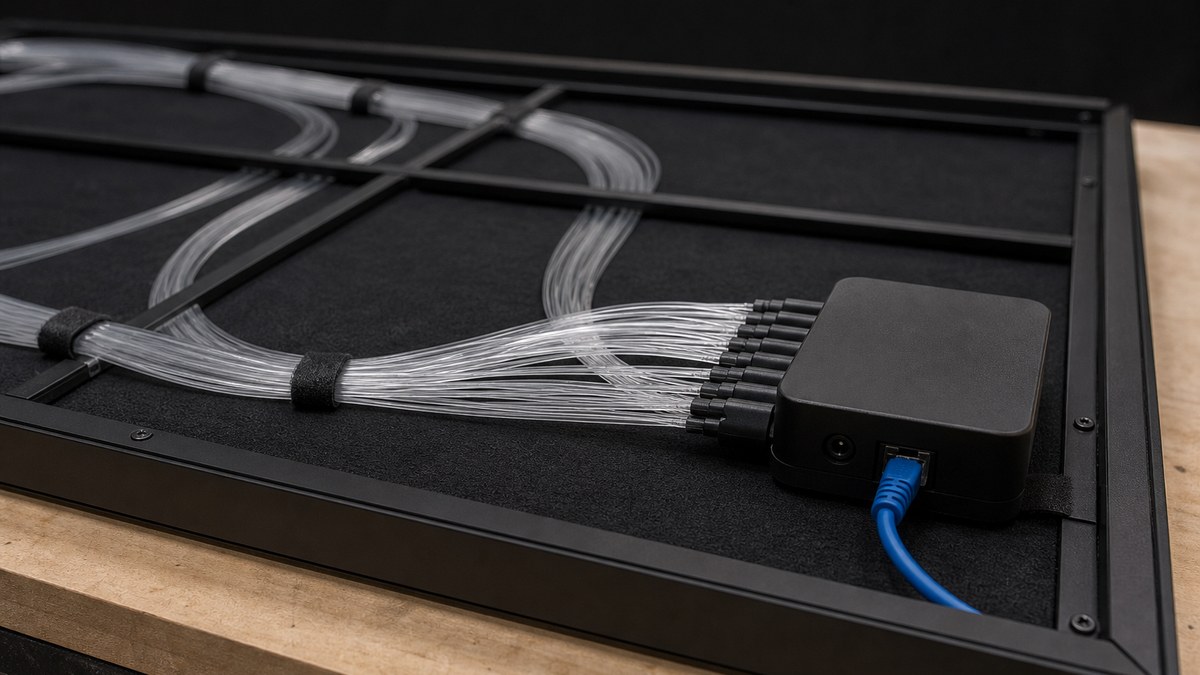
A star ceiling panel is a rigid ceiling tile with hundreds of fiber optic strands already threaded through its face. The fibers are bundled on the back of the panel and connected to an LED light engine. When the engine turns on, light travels through each strand and appears as a tiny, bright star on the front.
The big idea is simple: all the hard work happens in a workshop, not on your ceiling. Every strand is placed, glued, and trimmed before the panel ever ships. On install day, the panels mount to your ceiling or drop into your grid, and the power connects panel to panel with Cat5 cables. One outlet at the ceiling is usually all you need.
This is very different from a traditional fiber optic installation, where an installer drills a hole for every single star and threads fibers down from the attic. That method still has its place — our fiber optic lighting solutions team handles large custom builds — but for most bedrooms, theaters, and media rooms, premade panels deliver a denser, more even sky in a fraction of the time.
How are star ceiling panels made?
Most quality panels are built in layers. There is a rigid acoustic core, a fabric or finished face, the fiber optic strands, and a mounting frame. The fibers are made from PMMA, a clear optical plastic that carries light without heat. Quality PMMA fiber stays clear for 20+ years and never burns out, because the only part that makes light is the LED engine.
Why fiber optic and not LED dots? Some cheap "star panels" use tiny LED chips instead of fiber. LEDs look like dots, run warm, and fail one by one. Fiber optic stars are pinpoints of light with no electricity at the ceiling surface, which is why they look like a real night sky and last for decades.
Types of Star Ceiling Panels
When you shop for star ceiling panels, you'll see several names for similar products — starlight ceiling tiles, star light panels, starfield ceiling tiles, and fiber optic ceiling panels. They generally fall into four types.
1. Acoustic star ceiling panels
These are the premium choice for home theaters and media rooms. The panel core is a dense, sound-absorbing material wrapped in acoustic fabric, with fibers passing through the face. You get the star field and room treatment in one product. This is the type we build and install most often.
2. Drop ceiling star tiles (lay-in)
If your basement or office already has a suspended grid, lay-in star tiles simply replace your existing ceiling tiles. They come in standard 2′×2′ and 2′×4′ sizes and fit 15/16″ or 9/16″ tee grids, with square lay-in or tegular edges. This is the easiest upgrade for a finished basement.
3. Surface-mount decorative panels
For drywall ceilings, panels can mount directly to the ceiling like large framed artwork. You can cover the full ceiling edge-to-edge or create a "field" in the center with a border of plain ceiling around it. A center field is a popular way to control budget while keeping a dramatic look.
4. Shaped and backlit panels
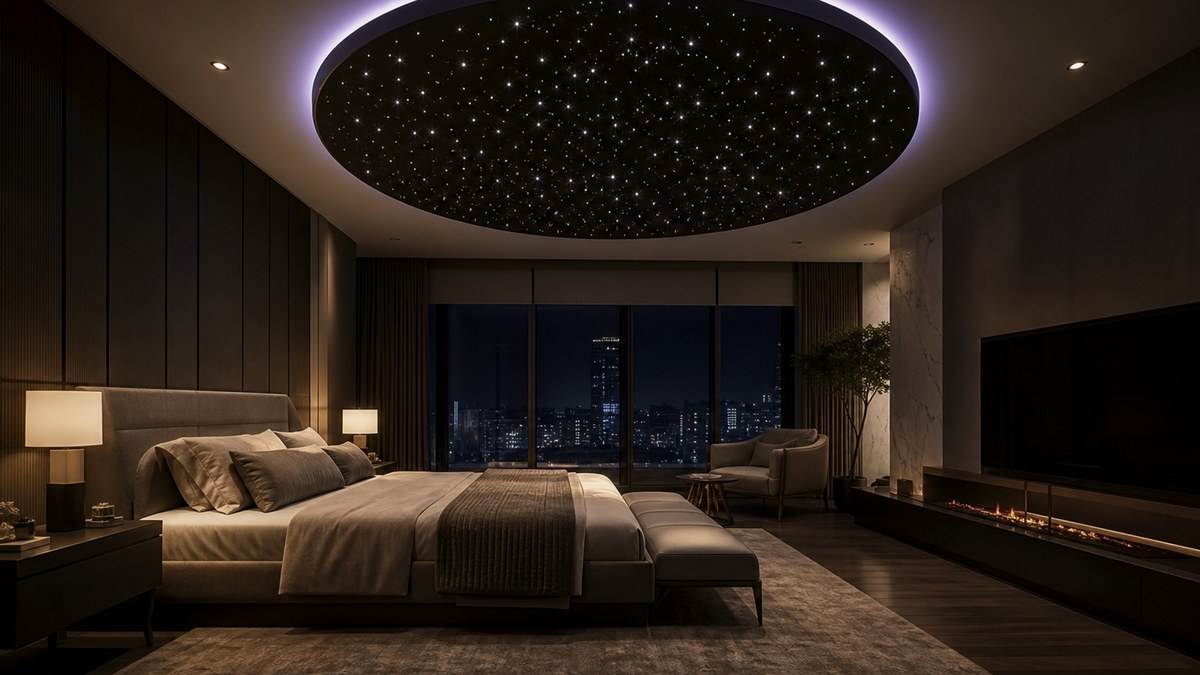
Circular, oval, or cloud-shaped panels with an RGBW LED halo around the edge create a floating night-sky effect. These are especially striking in bedrooms and theaters. Shapes are made to order, so your design can match your room instead of a standard rectangle — see our custom starlight ceiling design options for ideas.
| Panel Type | Best For | Ceiling Type | Acoustic Benefit |
|---|---|---|---|
| Acoustic star panels | Home theaters, media rooms, studios | Drywall or grid | High (NRC 1.0+ options) |
| Drop ceiling star tiles | Basements, offices, game rooms | Suspended grid | Moderate to high |
| Surface-mount panels | Bedrooms, living rooms, lounges | Drywall | Moderate to high |
| Shaped / backlit panels | Feature ceilings, nurseries, bars | Drywall | Varies by core |
Acoustic Star Ceiling Panels: Why Sound Matters
Many people search for star ceiling panels for the look, then discover the sound benefit is just as valuable. Hard drywall ceilings bounce sound around the room. That echo makes dialogue muddy and bass boomy, especially in a dedicated theater. An acoustic star ceiling absorbs those reflections right where they start.
What does NRC 1.0 mean?
NRC stands for Noise Reduction Coefficient. It's a rating from 0 to about 1.0+ that tells you how much sound a surface absorbs. A drywall ceiling is close to 0.05, meaning almost all sound bounces back. A panel rated NRC 1.0 absorbs nearly all the mid and high frequency sound that hits it. Our acoustic panels offer NRC 1.0+ options, which is the same class of performance used in professional listening rooms.
Are acoustic star panels the same as soundproofing?
No — and this is a common mix-up. "Soundproof star ceiling panels" is a popular search, but acoustic panels improve sound inside the room. They reduce echo and make movies and music clearer. They do not stop sound from traveling to the room above. True soundproofing needs mass, decoupling, and sealed gaps in the ceiling structure. Acoustic star panels are a great partner to soundproofing, but not a replacement.
Home theater tip: Acoustic star panels do double duty. Instead of buying separate ceiling treatment and a separate star system, one product handles both. That's a big reason most home theater starlight ceilings today are built with acoustic panels.
Star Ceiling Panel Sizes and Star Density
Panels are built to match standard ceiling grid modules, which keeps installation simple and costs predictable. Custom sizes and shapes are available when a room needs them.
| Panel Size | Area | Typical Star Count | Approx. Panel Price |
|---|---|---|---|
| 2′ × 2′ | 4 sq ft | 28–44 stars | ~$220 |
| 2′ × 4′ (48″ × 24″) | 8 sq ft | 56–88 stars | ~$440 |
| Custom shape | Any | 7–11 per sq ft | Quoted per design |
Star density matters more than most people expect. At 7 to 11 stars per square foot, premade panels create a much fuller sky than most hand-drilled DIY jobs, which often end up with about half that density. Stars are also mixed in size and brightness, so the ceiling looks like deep space instead of a pegboard.
How many panels do I need?
Measure your ceiling length and width in feet and multiply to get square feet. Divide by 4 for 2′×2′ panels or by 8 for 2′×4′ panels. A 12′×12′ center field, for example, uses 36 of the 2′×2′ panels. If you'd rather not do the math, send us your room dimensions and we'll lay out the panels for you.
How Much Do Star Ceiling Panels Cost?
Star ceiling pricing has two separate parts: the product and the installation. We always quote them separately, so you can see exactly what you're paying for. The panels cost about $55 per square foot delivered. Professional installation adds about $22 per square foot, for a total of about $77 per square foot installed.
Star ceiling panel cost by room size
| Project | Size | Panels Only (~$55/sq ft) | Fully Installed (~$77/sq ft) |
|---|---|---|---|
| Nursery / small room | 64–100 sq ft | $3,500 – $5,500 | $4,900 – $7,700 |
| Compact field | 10′ × 10′ (25 panels) | $5,500 | $7,700 |
| Bedroom | 100–150 sq ft | $5,500 – $8,250 | $7,700 – $11,550 |
| Home theater center field | 12′ × 12′ (36 panels) | $7,920 | $11,088 |
| Home theater full ceiling | 15′ × 15′ (225 sq ft) | $12,375 | $17,325 |
| Commercial space | 200–2,000+ sq ft | $15,000 – $150,000+ (custom quote) | |
For a deeper look at every factor that moves the price, read our full starlight ceiling cost guide.
What's included in the panel price?
The $55 per square foot price covers the finished panel: the acoustic core, fabric face, fiber optic stars placed at 7–11 per square foot, the built-in LED light engine, and the Cat5 connections between panels. Standard white starlight with dimming is included. That's why panels can look expensive next to a bag of loose fiber — you're buying a finished system, not a pile of parts. You can see full specs on our starlight ceiling panels page.
Custom effects are add-ons
Special effects are available, but they are custom add-ons with extra cost and are not included in base panel pricing. Typical ranges are:
| Custom Add-On | Typical Added Cost |
|---|---|
| Twinkling effect | $300 – $1,000+ |
| Shooting stars | $500 – $2,000+ |
| RGB color changing | $500 – $2,000+ |
| Smart home integration | $500 – $1,500+ |
| Constellation mapping | $1,000 – $3,000+ |
Budget tip: You don't need to cover every inch. A center field with a plain border keeps the "wow" and can cut the square footage — and the price — by 30% or more. It also leaves room around the edges for lights, vents, and speakers.
Get a Panel Layout and Price for Your Room
Send us your room size and we'll map out your panels, star density, and a clear quote with product and installation priced separately. Free consultation, no obligation.
(702) 738-2218 Get Your Free Quote →Premade Star Ceiling Panels vs. DIY Kits
A DIY fiber optic kit looks cheaper on paper. Once you add up every part — and your time — the gap gets much smaller than most people expect. Here's how the two compare for a typical room.
| Factor | Premade Star Panels | DIY Fiber Optic Kit |
|---|---|---|
| Material cost | ~$55/sq ft, all-in | $4,000 – $5,500+ once light engines, fiber, board, fabric, and hardware are added |
| Install time | 1–2 days with a 2-person crew | 5–7 full days for one person |
| Attic access | Not needed | Usually required (hot, cramped, often over 140°F in summer) |
| Star density | 7–11 stars per sq ft | Often about half that |
| Drilling & drywall repair | None | Hundreds of holes; patching often needed ($200–$600+) |
| Acoustic treatment | Built in | Only if you build it yourself |
| Finished quality | Consistent, factory-made | Depends entirely on your skill |
The light engine alone for a DIY build costs around $500, and most rooms need at least two. Bulk fiber spools run over $1,000 each. Add boards, fabric, anchors, adhesive, and paint, and a "cheap" kit reaches $4,000 to $5,500 before you've spent a week on a ladder. If you still want to build it yourself, our DIY starlight ceiling kits page walks through your options — including buying premade panels and installing them yourself.
Can I install star ceiling panels myself?
Yes. Premade panels are the most DIY-friendly way to get a real fiber optic sky, because the hardest work is already done. If you're handy and comfortable on a ladder, you can buy panels only at about $55 per square foot and mount them yourself. Most homeowners still choose professional starlight ceiling installation for larger rooms, since it adds a lifetime workmanship warranty and gets the job done in a day or two.
How Star Ceiling Panels Are Installed
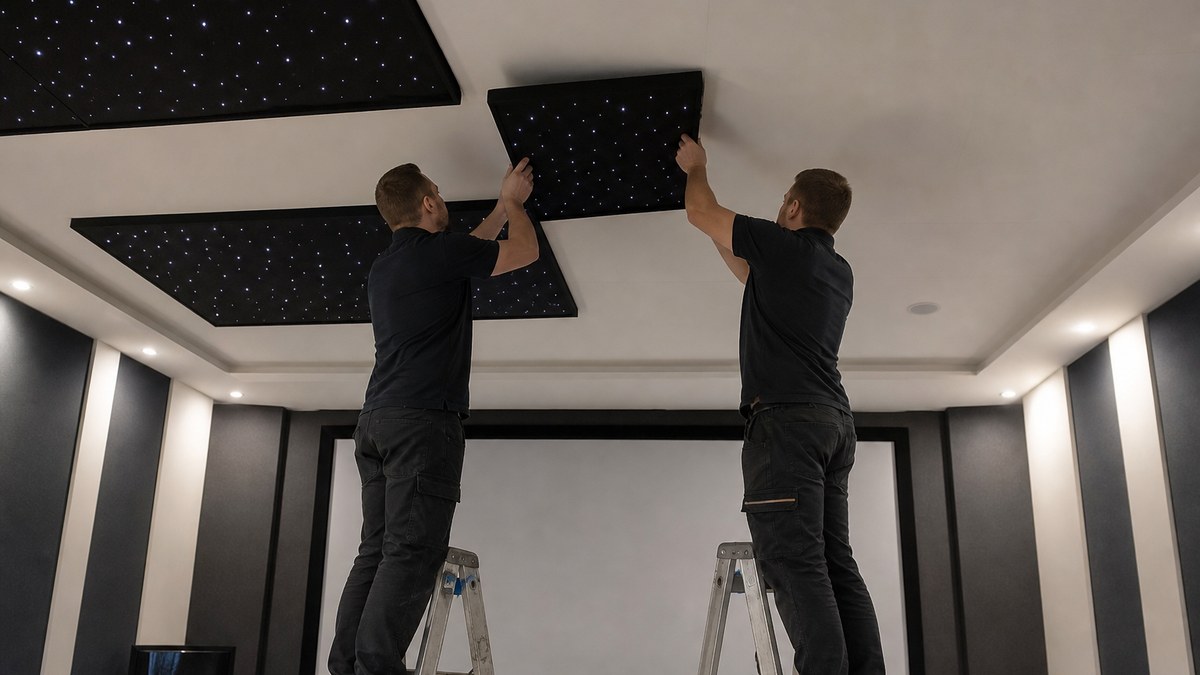
Panel installation is fast because it's mostly mounting and connecting. A professional 2-person crew covers 75 to 90 square feet per 8-hour day. Here's what a typical install looks like:
- Layout: The crew marks the panel field and confirms spacing around lights, vents, and speakers. Stars look most natural at least 8–10 inches from walls.
- Power: One outlet at the ceiling powers the system. Panels connect to each other with low-voltage Cat5 cables in a daisy chain.
- Mounting: Panels attach to the drywall with mounting hardware or drop into your existing grid. No holes are drilled through the ceiling for stars.
- Testing: The system is powered, tested, and commissioned the same day, including dimming and any custom effects.
- Handover: You get a walkthrough of the controls and a clean room — no dust, no drywall patching.
Curious how installers work in your area? Our guide to finding a star ceiling installer near you covers what to ask, and our locations page lists the cities we serve nationwide.
Best Rooms for Star Ceiling Panels
Home theaters and media rooms
This is where acoustic star panels shine. You get room treatment and a stunning sky in one product, and the dark ceiling helps your screen look brighter. A 12′×12′ center field is the most popular theater layout.
Bedrooms and nurseries
A soft white star field with dimming turns a bedroom into a calm retreat. Many homeowners pair panels with a smart plug so the stars come on at bedtime. See our starlight ceiling for bedroom page for layout ideas, and our residential starlight ceilings page for more rooms.
Basements and game rooms
If your basement has a drop ceiling, lay-in star tiles are the easiest upgrade in the house. You simply swap out old tiles for star tiles in the same grid.
Commercial spaces
Restaurants, lounges, spas, and hotel lobbies use star panels to create a memorable space guests photograph and share. Commercial projects are quoted per design — learn more about our commercial starlight ceilings. For outdoor and water features, our partners at pool and aquatic lighting handle the rest of the space.
How to Choose the Best Star Ceiling Panels
Before you buy, ask these questions. A good supplier will answer every one of them clearly.
- Is it fiber optic or LED dots? Choose true PMMA fiber optic for realistic pinpoint stars that last 20+ years.
- How many stars per square foot? Look for 7–11. Fewer than that can look sparse.
- What's the acoustic rating? For theaters, ask for NRC 1.0+ options.
- Is the light engine rated for long life? Quality LED engines are rated for 50,000+ hours.
- Is dimming included? It should be. Effects like twinkle and shooting stars are extra.
- What's the warranty? Expect a product warranty on the panels and a separate workmanship warranty on professional installation.
- Are product and install priced separately? Separate line items make it easy to compare quotes.
Want to see finished projects before you decide? Browse real rooms in our starlight ceiling gallery, or read our complete guide to a starlight ceiling in your house.
Commercial Lighting Applications From Our Network
Star ceilings are often one part of a larger lighting project. Our partner network covers the rest of the building. In Texas, we work alongside teams providing LED lighting solutions in Dallas, Fort Worth LED lighting, LED lighting in Plano, commercial LED lighting in Arlington, and Irving LED lighting services, plus Texas-wide LED lighting and wholesale LED solutions for larger projects.
Building a new theater room, studio, or office from the ground up? Modular building solutions and modular structures in Dallas can deliver the space, and we'll finish it with a star ceiling.
Frequently Asked Questions About Star Ceiling Panels
How much are star ceiling panels?
Premade fiber optic star ceiling panels cost about $55 per square foot, which is roughly $220 for a 2x2 panel and $440 for a 2x4 panel. Professional installation adds about $22 per square foot, for about $77 per square foot fully installed.
How much does it cost to put star panels in a home theater?
A 12x12 home theater center field uses 36 panels and costs about $7,920 for panels only or about $11,088 installed. A full 15x15 theater ceiling runs about $12,375 for panels or $17,325 installed. Custom effects like shooting stars are extra.
Are acoustic star ceiling panels worth it?
Yes, especially for home theaters and media rooms. Acoustic star panels absorb echo with NRC 1.0+ options while providing the star field, so one product replaces separate ceiling treatment and a separate star system.
Do acoustic star panels soundproof a room?
No. Acoustic star panels reduce echo and improve sound inside the room, but they do not block sound from traveling to other rooms. True soundproofing requires added mass, decoupling, and sealing in the ceiling structure.
What size are star ceiling panels?
Standard star ceiling panels come in 2x2 foot and 2x4 foot sizes to match common ceiling grids, including 15/16 inch and 9/16 inch tee grids. Custom sizes and shapes such as circles and clouds are also available.
How many stars are on a star ceiling panel?
Quality premade panels have 7 to 11 stars per square foot, which is about 28 to 44 stars on a 2x2 panel and 56 to 88 stars on a 2x4 panel. Stars are mixed in size and brightness for a natural look.
Can star ceiling panels go in a drop ceiling?
Yes. Lay-in star ceiling tiles replace standard tiles in a suspended grid with square or tegular edges. This makes basements and offices with drop ceilings one of the easiest places to add a star ceiling.
Is a premade star ceiling better than a DIY kit?
For most homes, yes. A DIY fiber optic kit often costs $4,000 to $5,500 or more in materials, takes one person 5 to 7 days, and usually needs attic access. Premade panels have about twice the star density, need no attic access, and a 2-person crew installs most rooms in 1 to 2 days.
Can I install star ceiling panels myself?
Yes. Premade panels are the easiest way to DIY a fiber optic star ceiling because the fibers and light engine are already built in. You mount the panels and connect them with Cat5 cables to a single ceiling outlet.
How long do fiber optic star ceiling panels last?
Quality PMMA fiber optic strands stay clear for 20 or more years and never burn out, and the LED light engine is rated for 50,000 or more hours. Our panels include a 2-year product warranty, and professional installation includes a lifetime workmanship warranty.
Ready for Your Own Star Ceiling?
Whether you want panels delivered for a DIY install or a complete turnkey installation, we'll design your sky, map every panel, and send a clear quote with product and installation priced separately. Every professional install includes a lifetime workmanship warranty.
(702) 738-2218 Get Your Free Quote →