
Acoustic Star Ceiling Panels: 2026 Home Theater Guide to NRC, Placement, Sound & Cost
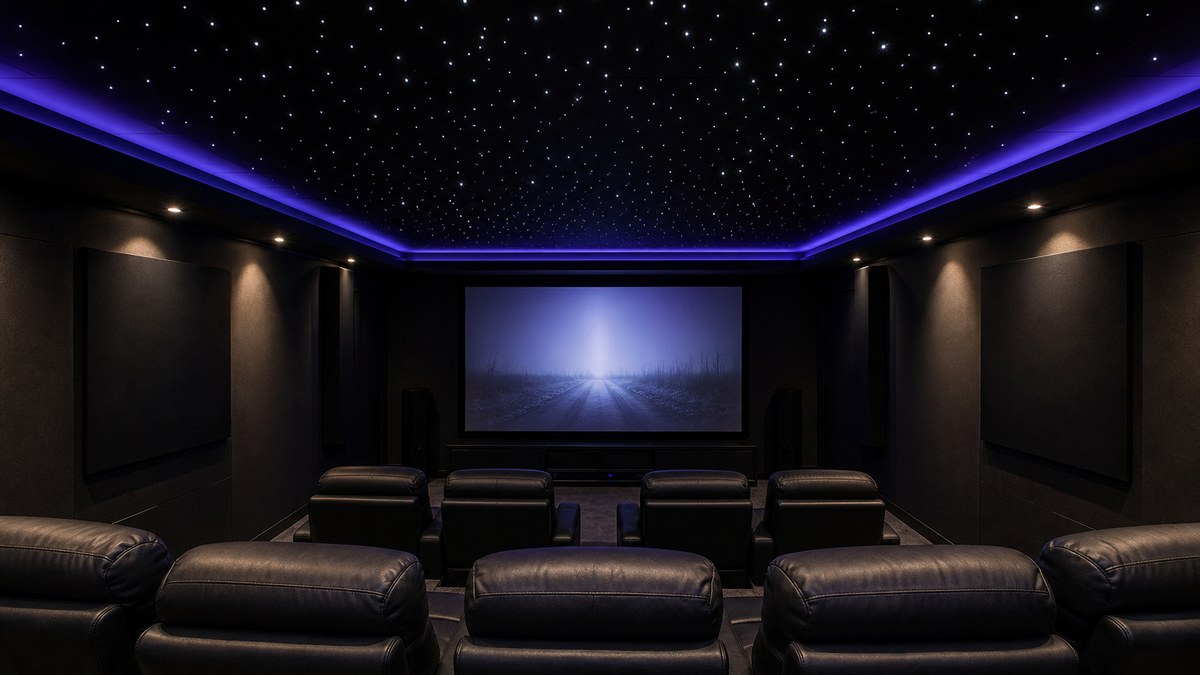
Acoustic star ceiling panels are fabric-wrapped sound-absorbing ceiling panels with fiber optic stars built into the face, so one product treats your home theater's echo and creates a night sky at the same time. In 2026 they cost about $55 per square foot for panels or about $77 per square foot installed, with NRC 1.0+ options that absorb nearly all the mid and high frequency sound that hits the ceiling.
Most people start shopping for the stars. Then they sit in a finished theater with a bare drywall ceiling and notice the problem: dialogue sounds thin, explosions smear together, and the room rings after every loud scene. The ceiling is the biggest untreated surface in most theaters. At American Starlight Ceilings, we build acoustic star panels specifically to fix that surface without giving up the look.
This guide goes deeper than a product page. You'll learn what NRC really means, how much of your ceiling to cover, exactly where the panels should go over your seats, how they work with Dolby Atmos speakers, what acoustic panels can and can't do, and what a realistic budget looks like for common theater sizes.
✦ Quick Answer: Are Acoustic Star Ceiling Panels Worth It for a Home Theater?
Yes, for most dedicated theaters and media rooms. They replace two separate purchases — ceiling acoustic treatment and a star ceiling system — with one product. The key numbers:
- Sound absorption: NRC 1.0+ options, versus about 0.05 for a bare drywall ceiling
- Target reverb: dedicated home theaters usually aim for an RT60 of about 0.3–0.4 seconds
- Where to place them: start with the first reflection zone between your front speakers and the seats, then expand over the seating area
- Star density: 7–11 fiber optic stars per sq ft with no electricity at the ceiling surface
- Cost: about $55/sq ft for panels, $22/sq ft for installation (typically $20–$24), about $77/sq ft installed
- Typical project: a 12′×12′ field over the seats is about $7,920 for panels or $11,088 installed
- Warranty: 2-year product warranty plus a lifetime workmanship warranty on professional installation
What Are Acoustic Star Ceiling Panels?
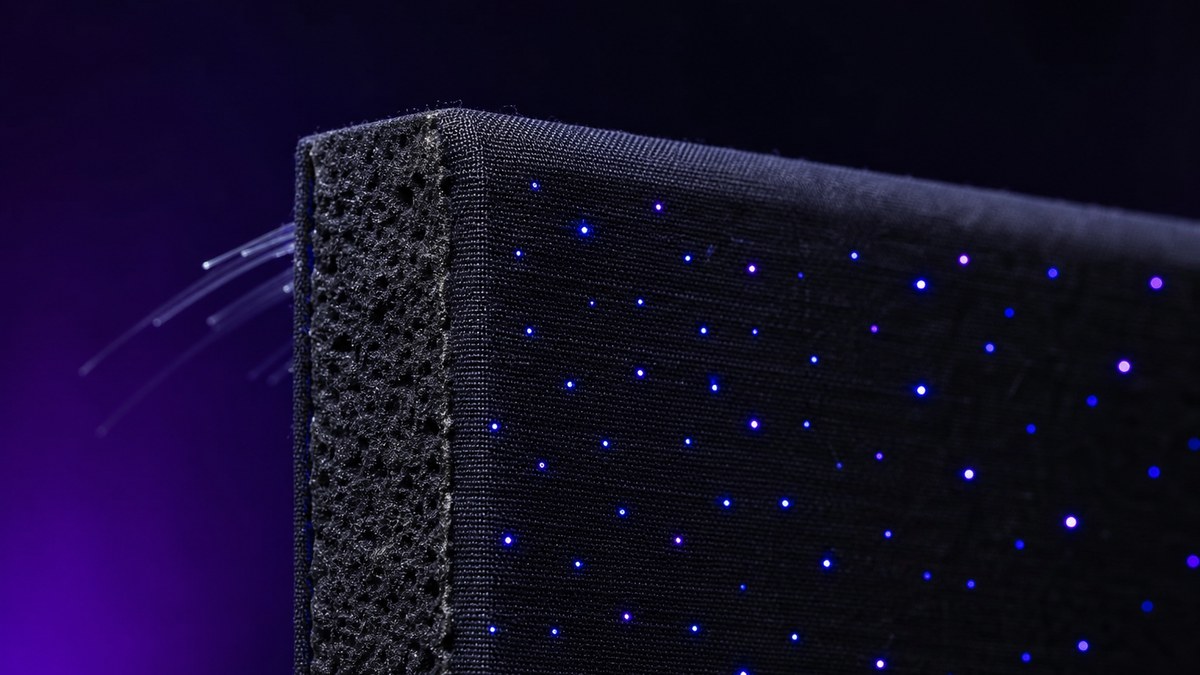
An acoustic star ceiling panel starts as a real acoustic panel. It has a rigid, porous core that traps sound energy, wrapped in an acoustically open fabric that lets sound pass through to the core. Fiber optic strands are threaded through the fabric face, and on the back they're bundled and connected to an LED light engine.
When the engine is on, each strand shows up as a pinpoint star. When your movie is playing, the panel quietly soaks up reflections that would otherwise bounce off the ceiling and back to your ears. You get the look of deep space and the sound of a treated room from the same square foot of ceiling.
This is different from a traditional hand-drilled star ceiling, where stars are pushed through drywall. Drywall is hard and reflective, so a drilled ceiling looks great but does nothing for sound. For large one-off builds, our partners in fiber optic lighting solutions still hand-build custom fields, but for theaters, acoustic panels are usually the better tool.
What are acoustic star panels made of?
Quality panels use a dense, porous core — the same class of material used in studio and cinema treatment — with a fabric face chosen for low sound reflection. The fibers are PMMA optical plastic, which carries light without heat and stays clear for 20+ years. The only powered part is the LED engine, which sits behind or beside the panel field where it's easy to reach.
Why the fabric matters: Black or charcoal acoustic fabric is the most popular theater choice. It hides the panel seams, makes the stars pop, and keeps light from your screen from bouncing back off the ceiling. That's why "black acoustic ceiling panels with stars" is one of the most common searches for this product.
NRC Explained: What the Acoustic Rating Actually Means
NRC stands for Noise Reduction Coefficient. It's a single number, usually from 0 to about 1.0 or a little higher, that shows how much sound a surface absorbs across the speech range. An NRC of 0.05 means about 5% of the sound is absorbed and 95% bounces back. An NRC of 1.0 means close to all of it is absorbed.
| Ceiling Surface | Typical NRC | What You Hear |
|---|---|---|
| Painted drywall | ~0.05 | Strong echo, harsh highs, muddy dialogue |
| Drilled star ceiling (drywall) | ~0.05 | Same as drywall — stars don't change the sound |
| 1-inch acoustic panel | ~0.70–0.85 | Controls high frequencies only |
| 2-inch acoustic panel | ~0.90–1.00 | Controls mids and highs — clear dialogue |
| Acoustic star panel (NRC 1.0+ option) | 1.0+ | Treated ceiling plus star field |
Does thicker mean better?
Generally, yes — thickness decides how low a panel can absorb. A 1-inch panel mostly handles frequencies above about 1,000 Hz. A 2-inch panel reaches down to about 500 Hz, which covers most of the human voice. A 4-inch panel reaches down toward 125 Hz. Density helps a panel absorb well within its range, but it's thickness that pushes the range lower.
For ceiling panels over the seats, the goal is mostly the mid and high frequencies that carry dialogue and effects detail. Deep bass is better handled with corner bass traps and good subwoofer placement, not the ceiling.
NRC vs STC: don't mix them up
NRC measures absorption inside the room. STC (Sound Transmission Class) measures how well a wall or ceiling blocks sound from passing through to another room. Acoustic star panels have a high NRC. They are not designed to raise STC, which is why they don't soundproof a theater on their own.
Why the Ceiling Is the Most Important Surface in a Home Theater
In a typical theater, the ceiling is the largest single surface in the room — often bigger than any one wall. Sound from your front speakers hits the ceiling between the screen and your seats and reflects straight down to your ears a few milliseconds after the direct sound. Your brain hears that as smear. Dialogue loses clarity, and the soundstage feels flat.
Treating that reflection is one of the fastest ways to improve a theater. And because the ceiling is where people want stars anyway, it's the one place where acoustic treatment and design can be the exact same product.
What RT60 should a home theater aim for?
RT60 is the time it takes sound to fade by 60 decibels after it stops. Dedicated home theaters generally aim for about 0.3 to 0.4 seconds. An untreated room with hard floors and drywall often rings much longer than that, which is why explosions sound "boomy" and voices sound hollow.
Here's a simple example using the classic Sabine formula. A 14′×18′ theater with a 9-foot ceiling holds about 2,268 cubic feet of air. To reach 0.4 seconds, that room needs about 278 sabins of total absorption. A 144 sq ft acoustic star field at around NRC 1.0 supplies roughly 144 sabins by itself — about half the total — while a bare drywall ceiling of the same size adds only about 7. Carpet, seating, and wall panels make up the rest.
Rule of thumb: Most treated theaters cover about 20–35% of their wall and ceiling surface with absorption, with more coverage in larger rooms. An acoustic star field over the seats is often the single biggest piece of that plan.
Where to Place Acoustic Star Panels Over Your Seats
You don't always need to cover the entire ceiling. Placement matters more than square footage. Here's the order we use when laying out a theater.
1. Find the first reflection zone
Sit in your main seat. Have a helper slide a mirror flat across the ceiling between you and the front speakers. Anywhere you can see a speaker in the mirror is a first reflection point. Mark those spots. That zone — usually a band starting a few feet in front of the first row — is the most important area to cover.
2. Extend over the seating area
Next, extend the field back over your seats. This controls reflections from the surround speakers and gives you a star field that fills your view when you lean back in a recliner. For most theaters, a 10′×12′ or 12′×12′ field centered over the seats does the job.
3. Leave a border and plan around fixtures
Stars look most natural at least 8–10 inches from walls. A plain border also leaves space for sconces, HVAC vents, sprinklers, and projector mounts. A center field with a border often cuts square footage — and cost — by 30% or more compared to wall-to-wall coverage.
4. Plan around Dolby Atmos and in-ceiling speakers
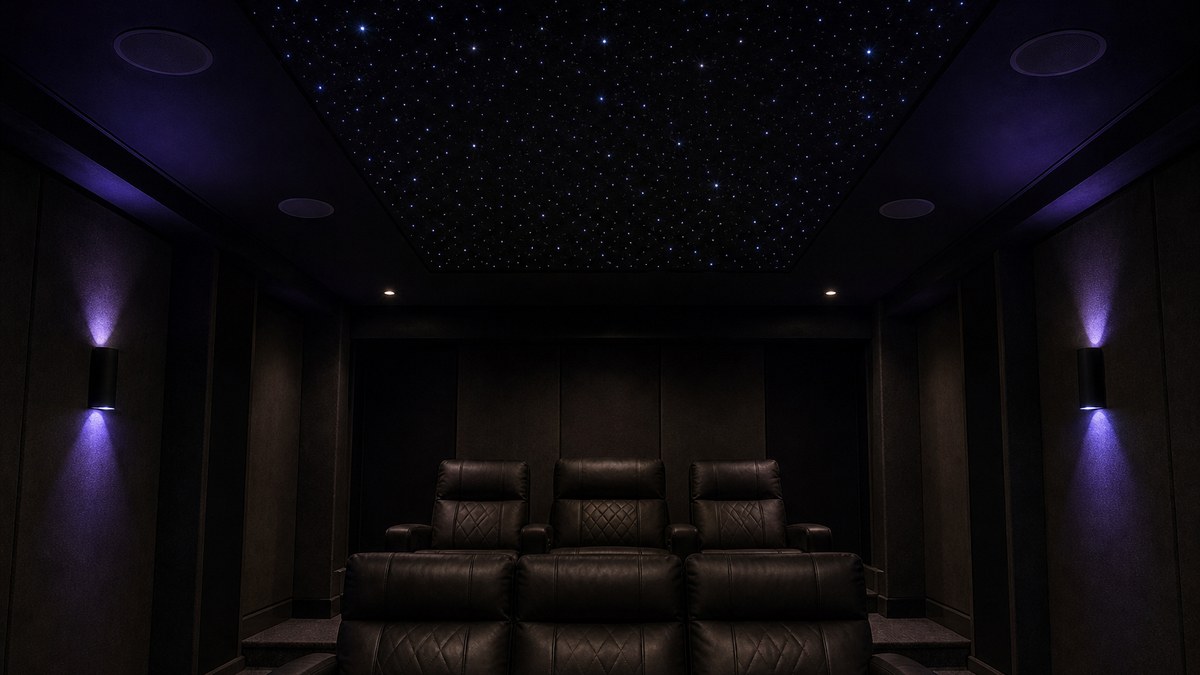
If your theater has overhead or in-ceiling height speakers, the panel layout is designed around them. Panels are cut or arranged so speaker grilles stay open and aimed correctly, and stars continue right up to the edges. It's much easier to plan this before the panels are built than to cut openings on site, so share your speaker layout when you request a quote.
| Theater Layout | Recommended Panel Coverage | Why |
|---|---|---|
| Small media room (1 row) | First reflection zone + over seats, ~80–120 sq ft | Covers the key reflections at the lowest cost |
| Dedicated theater (2 rows) | 12′×12′ center field, ~144 sq ft | Most popular layout — sound and visual impact balanced |
| Large theater (3+ rows) | Full ceiling with border, 200–300 sq ft | More seats need more coverage for even sound |
| Atmos theater | Field designed around height speakers | Keeps speaker grilles open and aimed correctly |
For more layout ideas and finished rooms, see our home theater starlight ceilings page.
Acoustic Star Panels vs. Soundproofing: What They Can and Can't Do
Search terms like "soundproof star ceiling panels" and "noise reducing star ceiling panels" are popular, so it's worth being clear. Acoustic star panels make sound inside your theater better. They cut echo, tighten dialogue, and reduce that ringing, fatiguing quality of a hard room. They also make a room feel quieter to sit in.
What they don't do is stop sound from reaching the bedroom above. Blocking sound transmission takes mass, decoupling (like resilient channel or isolation clips), and sealing every gap. Those are construction steps that happen before the ceiling is finished.
| Goal | Acoustic Star Panels | Soundproofing Construction |
|---|---|---|
| Reduce echo inside the room | Yes — main purpose | Little effect |
| Clearer dialogue | Yes | No |
| Stop sound reaching other rooms | Minimal | Yes — main purpose |
| Star field / visual design | Yes, built in | No |
| When it's installed | On a finished ceiling | During framing and drywall |
Best of both: If you're building a new theater, do the soundproofing in the ceiling structure first, then mount acoustic star panels on the finished ceiling. The two work together — one keeps sound in, the other makes it sound great.
Acoustic Star Ceiling Panel Cost for Home Theaters
We price the product and the installation separately, so you can see exactly where your money goes. Acoustic star panels cost about $55 per square foot delivered. Professional installation adds about $22 per square foot (typically $20–$24, depending on ceiling height and layout), for about $77 per square foot installed.
Cost by theater layout
| Project | Area | Panels Only (~$55/sq ft) | Fully Installed (~$77/sq ft) |
|---|---|---|---|
| First reflection zone only | 8′ × 10′ (80 sq ft) | ~$4,400 | ~$6,160 |
| Media room field | 10′ × 12′ (120 sq ft) | ~$6,600 | ~$9,240 |
| Theater center field | 12′ × 12′ (144 sq ft) | ~$7,920 | ~$11,088 |
| Full theater ceiling | 15′ × 15′ (225 sq ft) | ~$12,375 | ~$17,325 |
| Large theater ceiling | 14′ × 18′ (252 sq ft) | ~$13,860 | ~$19,404 |
These are planning ranges, not a final quote — your exact price depends on the layout, cutouts for speakers and lights, and ceiling height. For every factor that affects pricing, see our full starlight ceiling cost guide.
What's included — and what's extra
The panel price covers the acoustic core, fabric face, fiber optic stars at 7–11 per square foot, the LED light engine, Cat5 connections between panels, and standard white starlight with dimming. Special effects are custom add-ons with extra cost and are not included in base panel pricing:
| Custom Add-On | Typical Added Cost |
|---|---|
| Twinkling effect | $300 – $1,000+ |
| Shooting stars | $500 – $2,000+ |
| RGB color changing | $500 – $2,000+ |
| Smart home / theater control integration | $500 – $1,500+ |
| Constellation mapping | $1,000 – $3,000+ |
Is it cheaper than buying treatment and stars separately?
Usually, yes, once you count the whole project. Separate ceiling treatment plus a separate hand-drilled star system means paying for two products, two installs, and hundreds of holes. With acoustic star panels, one product and one install handle both. You can compare the full breakdown in our star ceiling panels buying guide.
Get an Acoustic Panel Layout for Your Theater
Send us your room size, seating rows, and speaker layout. We'll map your first reflection zone, design the star field, and send a clear quote with product and installation priced separately.
(702) 738-2218 Get Your Free Quote →How Acoustic Star Panels Are Installed in a Theater
Because the stars are built in at the workshop, installation is mostly layout, mounting, and connecting. A professional 2-person crew covers 75 to 90 square feet per 8-hour day, so most theater fields are done in one to two days.
- Layout: The crew marks the first reflection zone, the field boundaries, and every speaker, light, and vent location.
- Power: One outlet at the ceiling powers the light engines. Panels daisy-chain with low-voltage Cat5 cables.
- Mounting: Panels attach to the drywall with mounting hardware, or drop into an existing grid in basement theaters. No holes are drilled through the ceiling for stars.
- Speaker integration: Openings for height speakers are aligned and finished cleanly.
- Testing and handover: Stars, dimming, and any custom effects are tested, and you get a walkthrough of the controls.
Handy homeowners can buy panels only and mount them, since the hardest work is already done — our DIY starlight ceiling kits page explains the options. For most theaters, professional starlight ceiling installation is worth it for the speaker cutouts alone, and it adds a lifetime workmanship warranty on top of the 2-year product warranty.
Can acoustic star panels go in a basement drop ceiling?
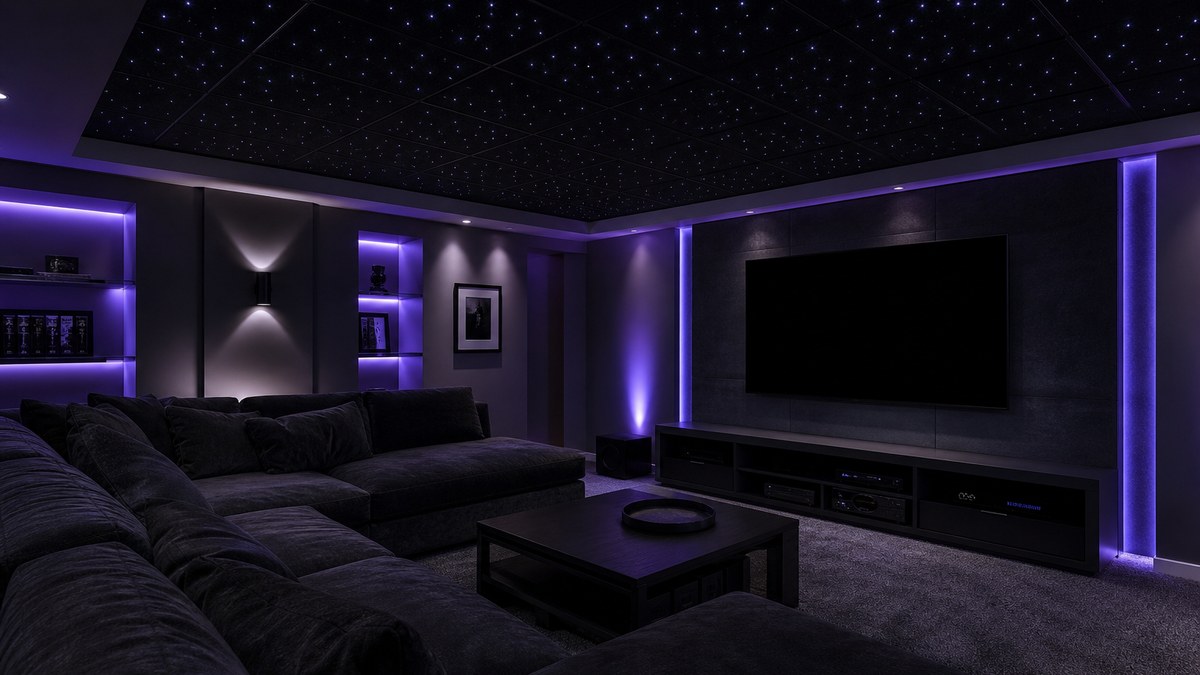
Yes. Many basement theaters have a suspended grid, and lay-in acoustic star tiles simply replace the existing tiles in standard 2′×2′ or 2′×4′ openings. It's one of the easiest theater upgrades there is.
Other Rooms That Benefit From Acoustic Star Panels
Home theaters get the most attention, but acoustic star panels solve the same problem anywhere sound and atmosphere matter.
Media rooms and game rooms
Open media rooms with hard floors can be louder than dedicated theaters. A star field over the TV seating area calms the echo and makes the room feel intentional. See more on our residential starlight ceilings page.
Bedrooms and music rooms
In a bedroom, acoustic panels make the room feel quieter and softer, and a dimmed star field is a calm way to end the day. Get layout ideas on our starlight ceiling for bedroom page.
Commercial theaters, lounges, and studios
Screening rooms, private cinemas, lounges, and podcast studios use acoustic star fields to control noise while creating a memorable space. Learn more about commercial starlight ceilings, or explore shaped and themed fields through custom starlight ceiling design.
How to Choose Acoustic Star Ceiling Panels: 8-Point Checklist
- Real acoustic core: Ask for the NRC rating. For theaters, look for NRC 1.0+ options.
- Panel thickness: Thicker panels absorb lower frequencies. Ask what range the panel covers.
- True fiber optic stars: PMMA fiber, not LED dots. Fiber gives realistic pinpoints with no heat at the surface.
- Star density: 7–11 stars per square foot for a full, natural sky.
- Fabric color: Black or charcoal for theaters to reduce light bounce from the screen.
- Speaker planning: The layout should include your Atmos or in-ceiling speakers from the start.
- Clear pricing: Product and installation quoted separately, with add-ons like twinkle and shooting stars listed as extras.
- Two warranties: A product warranty on the panels and a workmanship warranty on the install.
See finished rooms in our starlight ceiling gallery, read the complete guide to a starlight ceiling in your house, or check our locations page for the cities we serve. If you're comparing local installers, our guide to finding a star ceiling installer near you lists the questions to ask.
Commercial Lighting Applications From Our Network
A theater or entertainment space is often part of a bigger lighting project. In Texas, our network partners provide LED lighting solutions in Dallas, Fort Worth LED lighting, LED lighting in Plano, commercial LED lighting in Arlington, and Irving LED lighting services, along with Texas-wide LED lighting and wholesale LED solutions for larger jobs.
Adding a backyard or pool area to the entertainment plan? Our partners in pool and aquatic lighting can finish the outdoor space. Building a standalone screening room or studio? Modular building solutions and modular structures in Dallas can deliver the building, and we'll finish it with an acoustic star ceiling.
Frequently Asked Questions About Acoustic Star Ceiling Panels
What are acoustic star ceiling panels?
Acoustic star ceiling panels are fabric-wrapped sound-absorbing panels with fiber optic stars built into the face. They reduce echo like standard acoustic treatment while creating a night-sky star field, so one product handles both sound and design.
How much do acoustic star ceiling panels cost?
Acoustic star ceiling panels cost about $55 per square foot for panels only. Professional installation adds about $22 per square foot, typically $20 to $24, for about $77 per square foot installed. A 12x12 home theater field is about $7,920 for panels or $11,088 installed.
What NRC rating do I need for a home theater ceiling?
For a home theater ceiling, look for acoustic panels with an NRC close to 1.0. Our acoustic star panels offer NRC 1.0+ options, compared with about 0.05 for a bare drywall ceiling.
Do acoustic star ceiling panels soundproof a room?
No. Acoustic star panels reduce echo and improve clarity inside the room, but they do not block sound from reaching other rooms. Soundproofing requires added mass, decoupling, and sealing in the ceiling structure, and it works well together with acoustic panels.
Where should acoustic panels go on a home theater ceiling?
Start with the first reflection zone between the front speakers and the main seats, which you can find with the mirror method. Then extend the field over the seating area and leave an 8 to 10 inch border from the walls.
How much of my theater ceiling should be covered?
Most theaters get great results from a center field over the seats, such as 10x12 or 12x12 feet. Treated theaters typically cover about 20 to 35 percent of total wall and ceiling surface, and the ceiling field is often the largest part of that.
Can acoustic star panels work with Dolby Atmos speakers?
Yes. The panel layout is designed around in-ceiling or overhead height speakers so the grilles stay open and aimed correctly. Share your speaker plan when you request a quote so openings are planned before the panels are built.
Are black acoustic ceiling panels with stars better for theaters?
Black or charcoal fabric is the most popular choice for theaters because it hides seams, makes the stars stand out, and reduces light reflected from the screen back into the room.
Can I put acoustic star ceiling tiles in a drop ceiling?
Yes. Lay-in acoustic star tiles replace standard 2x2 or 2x4 tiles in a suspended grid, which makes basement theaters one of the easiest places to add an acoustic star ceiling.
How long do acoustic star ceiling panels last?
PMMA fiber optic strands stay clear for 20 or more years and never burn out, and quality LED light engines are rated for 50,000 or more hours. Our panels include a 2-year product warranty, and professional installation includes a lifetime workmanship warranty.
Make Your Theater Look Like Space and Sound Like a Cinema
We'll design an acoustic star field around your seats and speakers, price the panels and installation separately, and back every professional install with a lifetime workmanship warranty plus a 2-year product warranty.
(702) 738-2218 Get Your Free Quote →