
Low Voltage Star Ceiling Panels: 2026 Guide to LED vs Fiber Optic, Dimmable, Modular & Remote-Control Panels
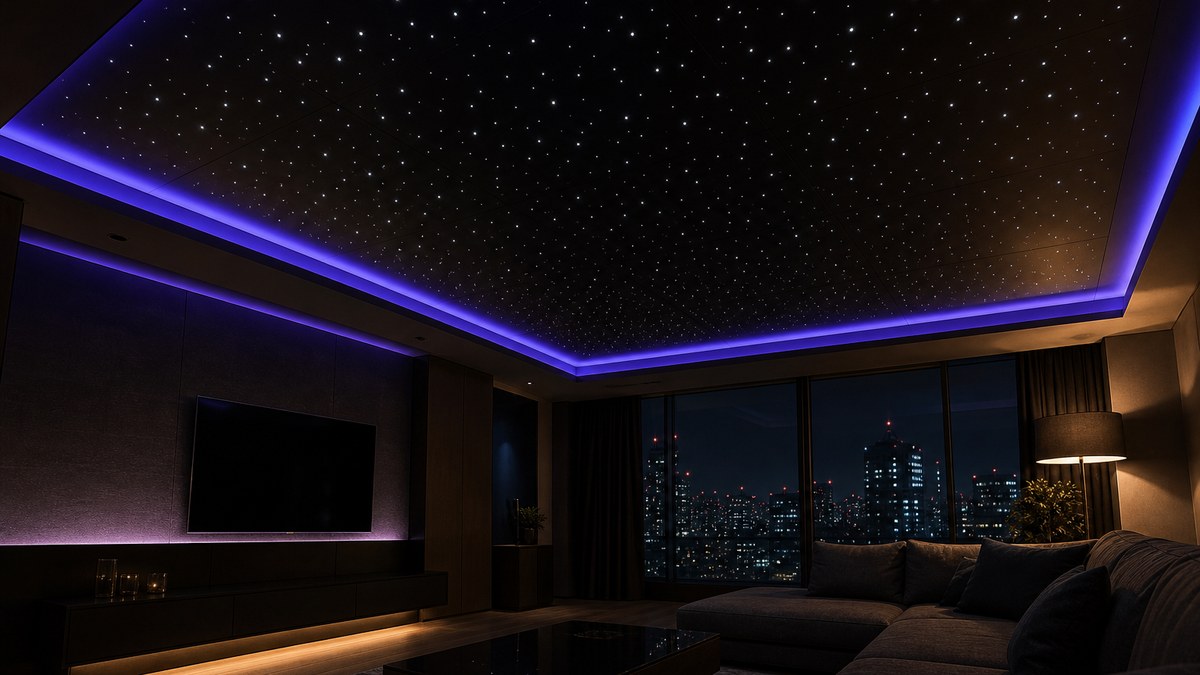
Low voltage star ceiling panels are premade ceiling panels whose stars are lit by a small LED light engine running on low-voltage DC power, linked panel to panel with Cat5 cable and powered from one standard outlet. In 2026 they cost about $55 per square foot for the panels or about $77 per square foot installed, and they are the reason a star ceiling no longer needs an electrician, an attic crawl, or a week of drilling.
Shoppers run into a pile of confusing labels: LED star ceiling panels, dimmable panels, modular panels, pre-wired panels, remote-control panels. Most of these describe the same handful of design choices — how the panel makes light, how it gets power, how you control it, and how the pieces fit together. At American Starlight Ceilings, we build and install these systems every week, so this guide translates the spec-sheet language into plain English.
You'll learn the real difference between LED and fiber optic star panels, what "low voltage" means for safety and wiring, how dimming and remote control actually work, why modular 2x2 and 2x4 panels make planning easy, and what each option costs for a real room. By the end, you'll know exactly which questions to ask before you buy.
✦ Quick Answer: What Are Low Voltage Star Ceiling Panels?
They are pre-wired star panels powered by a low-voltage LED light engine instead of household line voltage at the ceiling. The key numbers for 2026:
- Power: one standard outlet feeds a plug-in power supply; panels run on low-voltage DC and link with Cat5 cable
- Energy use: a typical room field draws roughly 10–30 watts — less than one old incandescent bulb
- Light source: quality panels use fiber optic stars lit by an LED engine, not LED chips glued to the face
- Dimming: white starlight with dimming is included; twinkle, shooting stars, RGB color and smart control are extra-cost add-ons
- Modular sizes: 2x2 (about $220) and 2x4 (about $440) panels at about $55 per sq ft
- Installed cost: about $77 per sq ft — around $7,700 for a 10x10 room
- Lifespan & warranty: fibers stay clear 20+ years, LED engines are rated 50,000+ hours, plus a 2-year product warranty and lifetime workmanship warranty
What Does "Low Voltage" Mean for a Star Ceiling?
Your home's outlets deliver about 120 volts AC. That's line voltage, and running it to light fixtures normally means an electrician, junction boxes, and permits. A low-voltage star ceiling takes a different route. A plug-in power supply converts line voltage into low-voltage DC — commonly 12 or 24 volts — and only that low-voltage power travels to the light engine.
From there, the light engine turns electricity into light and sends it through the fiber optic strands. The stars themselves carry no electricity at all. That's why a fiber star field stays cool to the touch and why there's no current anywhere on the ceiling face.
Why low voltage matters for safety
Low-voltage lighting runs on power-limited circuits. In the U.S. electrical code, Class 2 circuits are capped at 100 VA, which keeps fire and shock risk very low. For you, that means less heat in the ceiling, less risk around kids and pets, and simpler wiring. It's also why we can link panels with ordinary-looking Cat5 cable rather than heavy electrical cable.
Does a low voltage star ceiling need an electrician?
Usually not. If there's an outlet near the ceiling or in the space above a drop ceiling, the system plugs right in. You only need an electrician if no outlet is available where the power supply will sit. Missing outlets are actually the #1 cause of install-day delays, so check this early. Commercial projects with return-air plenums use plenum-rated low-voltage cable — see our commercial star ceiling guide for code details.
Plain-English summary: High voltage stays in the wall outlet. Low voltage runs to the light engine. Only light — not electricity — reaches the stars. That three-step chain is what makes modern star panels safe, cool, and easy to install.
LED Star Ceiling Panels vs. Fiber Optic Star Panels
"LED star ceiling panels" is one of the most searched phrases in this category, and it means two very different products. Some sellers use it for fiber optic panels powered by an LED engine. Others sell panels with tiny LED chips mounted directly on the face. They look similar in a product photo. They look nothing alike on your ceiling.
LED-chip panels
Here, every "star" is a small LED. The panel needs wiring running to each chip, so there's live low-voltage current across the face. LED chips tend to look like dots or pinholes of colored plastic rather than pinpoints of light. They also generate a little heat at each point, and when one fails, you see a dark spot that's hard to fix.
Fiber optic panels with an LED light engine
This is the system we install. A single LED light engine sits behind or above the panel. Hundreds of PMMA fiber strands carry its light to the face, where each strand ends as a crisp pinpoint star. Strands come in mixed sizes, so you get bright stars, dim stars, and a deep-space look. Nothing at the ceiling face uses electricity, and fibers don't burn out.
| Feature | Fiber Optic Panels (LED Engine) | LED-Chip Panels |
|---|---|---|
| How stars look | Pinpoint stars in mixed sizes | Visible dots, often uniform |
| Electricity at the ceiling face | None — light only | Low-voltage current at every chip |
| Heat at the stars | None | Small amount per chip |
| Star density | 7–11 stars per sq ft | Varies; often fewer |
| When something fails | Service one engine; fibers last 20+ years | Individual dark spots across the face |
| Effects | Twinkle, shooting stars, RGB via engine upgrades (add-ons) | Limited by the chips installed |
If you're comparing quotes, ask one simple question: "Are the stars fiber optic strands or LED chips?" A good supplier will answer immediately. For a deeper look at fiber, our partners at 360 Fiber Lighting explain how fiber optic lighting solutions are used on buildings, pools, and large custom projects.
How Pre-Wired Low Voltage Star Panels Are Powered
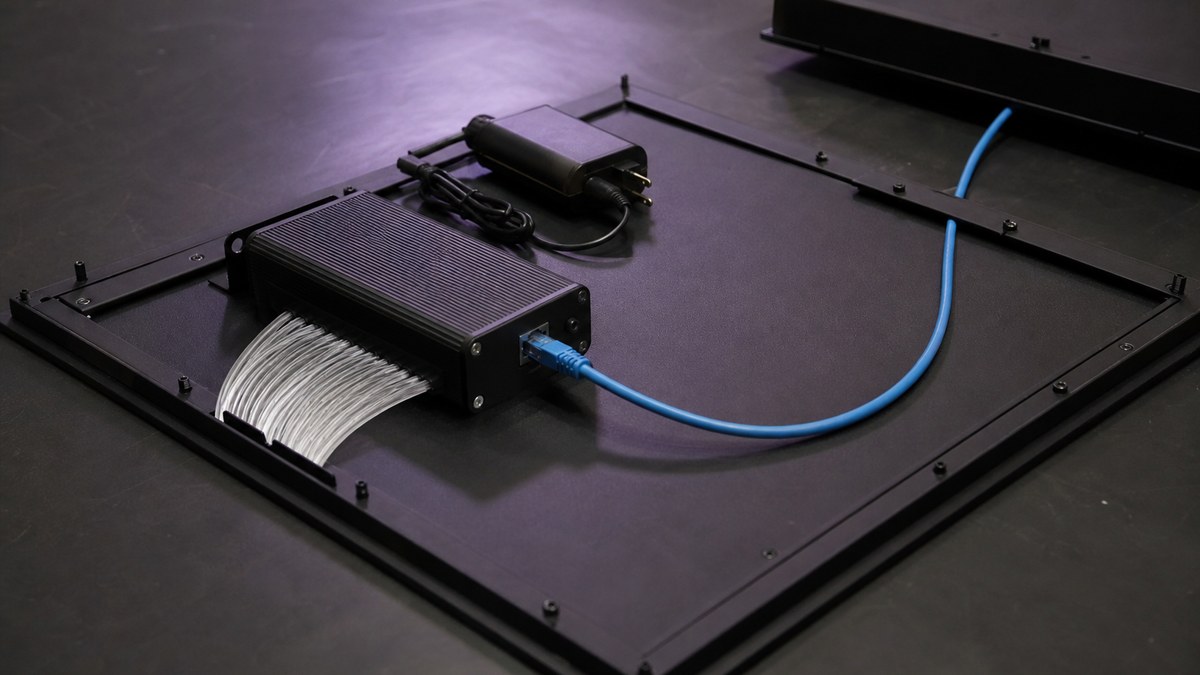
"Pre-wired" means the hard work happened in the workshop. Every fiber is already threaded, glued, and trimmed, and the light engine is already attached. On install day, there's nothing to drill, thread, or splice at your ceiling.
The Cat5 daisy chain
Panels connect to each other with Cat5 cable in a daisy chain: power supply to panel one, panel one to panel two, and so on across the field. The cable carries low-voltage power and the control signal for dimming and effects. One outlet usually powers an entire room's field, and the connections hide behind the panels.
Where does the power supply go?
On drywall ceilings, the power supply typically sits near an outlet in a closet, attic hatch, soffit, or an equipment rack. In basements with suspended grids, it sits in the plenum space above the tiles. In home theaters, it often lives in the AV rack so it can tie into your control system. Wherever it goes, it should be accessible and ventilated so it can be serviced later.
How much power does a star ceiling use?
Very little. A typical residential field draws about 10–30 watts total. Running a 20-watt system four hours a night uses about 29 kWh a year — roughly a few dollars of electricity at average U.S. rates. That's one of the quiet benefits of LED-powered fiber: a whole night sky for less power than a single old-fashioned light bulb.
| Component | What It Does | Where It Lives |
|---|---|---|
| Plug-in power supply | Converts 120V AC to low-voltage DC | Near an outlet: closet, attic, plenum, AV rack |
| LED light engine | Makes the light; controls dimming and effects | Built into or behind each panel |
| Cat5 link cables | Carry low-voltage power and control between panels | Hidden behind the panels |
| Fiber optic strands | Carry light to the face; each strand is one star | Threaded through the panel face |
| Controller / remote | Turns stars on/off, dims, runs effects | Handheld, wall, app, or smart-home hub |
Dimmable Star Ceiling Panels: What's Included and What's Extra
Dimming is the single most important control on a star ceiling. Full brightness looks great for showing off. Ten percent brightness is what you actually want for sleeping, watching a movie, or winding down. That's why white starlight with dimming is included in our base panel price.
How dimming works
Because the light comes from one LED engine, dimming the engine dims every star in the field evenly. You don't adjust hundreds of lights — just one. Good engines dim smoothly all the way down without flicker, which matters a lot in a dark theater where any flicker is easy to spot.
Custom effects are add-ons
Beyond white starlight and dimming, special effects are custom add-ons with extra cost. They are never included in base panel pricing. Typical ranges:
| Feature | Included? | Typical Added Cost |
|---|---|---|
| White starlight | Yes | Included in ~$55/sq ft |
| Dimming | Yes | Included in ~$55/sq ft |
| Twinkling effect | Add-on | $300 – $1,000+ |
| Shooting stars | Add-on | $500 – $2,000+ |
| RGB / RGBW color changing | Add-on | $500 – $2,000+ |
| Smart home / app / voice control | Add-on | $500 – $1,500+ |
| Constellation mapping | Add-on | $1,000 – $3,000+ |
Want color? Our color changing star ceiling guide explains RGB vs RGBW engines in detail. For a full breakdown of every effect and what real luxury projects cost, see our custom star ceiling cost guide.
Plan effects before install day. Twinkle and shooting-star effects depend on the engine and fiber layout. Adding them later is possible but usually costs more than choosing them up front, so decide during design — even if you add the controller later.
Remote Control Star Ceiling Panels: IR, RF, App & Voice
Every system needs a way to turn the stars on, off, and dim them. How that happens depends on where the engine sits and how you want to live with it.
IR remotes
Infrared remotes are cheap and common on budget kits, but they need a clear line of sight to the receiver. If the engine is hidden above the ceiling or in a closet — which is exactly where it should be — an IR remote often won't work reliably.
RF remotes and wall controls
Radio-frequency remotes work through walls and ceilings, so they're a better fit for hidden engines. A wall-mounted control near the door is another easy choice, especially in bedrooms and nurseries.
App, Wi-Fi and voice control
Smart control lets you set schedules, scenes, and voice commands through a phone app or a smart-home system. Stars can fade on at bedtime and off at sunrise, or tie into a theater's "movie mode." Smart integration is a custom add-on, typically $500 to $1,500+.
| Control Type | Works With Hidden Engine? | Best For |
|---|---|---|
| IR remote | Often no (needs line of sight) | Small exposed setups only |
| RF remote | Yes | Bedrooms, media rooms |
| Wall control | Yes | Nurseries, kids' rooms, guest rooms |
| App / Wi-Fi / voice | Yes | Theaters, smart homes, schedules |
Modular Star Ceiling Panels: 2x2 and 2x4 Building Blocks
Modular means the star field is built from standard-size units that fit together like tiles. It's the reason star ceiling planning is now simple math instead of guesswork. Each panel is a complete, pre-wired unit, so you can start small, expand later, or replace a single panel without touching the rest.
| Panel Size | Area | Stars (7–11 per sq ft) | Approx. Panel Price | Approx. Installed |
|---|---|---|---|---|
| 2′ × 2′ | 4 sq ft | 28–44 | ~$220 | ~$308 |
| 2′ × 4′ | 8 sq ft | 56–88 | ~$440 | ~$616 |
| Custom shape | Any | 7–11 per sq ft | Quoted per design | Quoted per design |
Why modular panels save money
You don't need to cover the whole ceiling. A center field with a plain border of 8–10 inches or more keeps the wow and can cut square footage — and cost — by 30% or more. It also leaves room for recessed lights, vents, and speakers. Because the system is modular, you can add a row of panels later if you want a bigger sky.
Modular panels in drop ceilings
Modular sizes match standard suspended-ceiling grids, so lay-in star tiles drop straight into a 15/16″ or 9/16″ tee grid. You'll want about 3–4 inches of clearance above the grid for the engine and cables. Our star ceiling tiles for drop ceilings guide covers grid sizes, edge types, and basement layouts step by step.
How Much Do Low Voltage Star Ceiling Panels Cost?
Pricing has two parts: the panels and the installation. We always quote them separately. Panels cost about $55 per square foot delivered, including the fiber stars, the built-in LED engine, white dimming, and Cat5 links. Professional installation adds about $22 per square foot (typically $20–$24), for about $77 per square foot installed.
| Project | Size | Panels Only (~$55/sq ft) | Installed (~$77/sq ft) |
|---|---|---|---|
| Feature over a bed | 4′ × 8′ (32 sq ft) | $1,760 | $2,464 |
| Center field | 8′ × 8′ (64 sq ft) | $3,520 | $4,928 |
| Bedroom full ceiling | 10′ × 10′ (100 sq ft) | $5,500 | $7,700 |
| Primary suite / theater field | 12′ × 12′ (144 sq ft) | $7,920 | $11,088 |
| Media room full ceiling | 12′ × 15′ (180 sq ft) | $9,900 | $13,860 |
These numbers are guides, not quotes — ceiling height, layout complexity, and add-ons change the total. For every factor that moves the price, read our starlight ceiling cost guide and our star ceiling panels price guide. Planning a theater? Our home theater star ceiling cost guide budgets by room size and seating rows.
Get a Low Voltage Panel Layout for Your Room
Send us your room size and outlet location. We'll map your modular panels, power supply spot, and controls, then send a clear quote with product and installation priced separately. Free consultation, no obligation.
(702) 738-2218 Get Your Free Quote →Installing Low Voltage Star Ceiling Panels
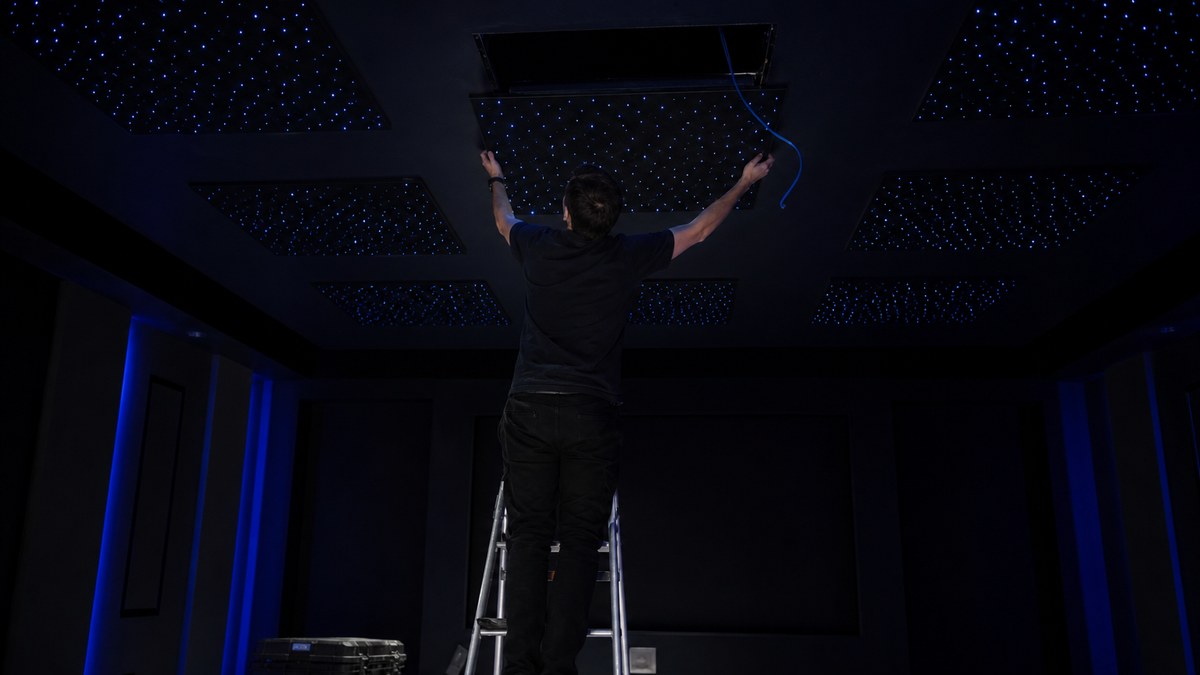
Because panels arrive pre-wired, installation is mostly layout, mounting, and plugging in. A professional 2-person crew covers about 75–90 square feet per day, so most rooms are done in 1–2 days.
- Confirm power: Locate the outlet and choose an accessible, ventilated spot for the power supply.
- Map obstacles: Mark recessed lights, vents, speakers, and smoke detectors so the layout works around them.
- Lay out the field: Snap chalk lines from a center reference and keep an 8–10 inch border from walls.
- Mount panels: Attach panels to drywall from the center outward, or drop lay-in tiles into the grid.
- Link with Cat5: Daisy-chain the panels back to the power supply and controller.
- Test and commission: Power up, check every panel, set dimming and any add-on effects, and walk you through the controls.
Want the full process for drywall, drop ceilings, and theaters? Read our starlight ceiling installation guide. If you're handy, premade panels are also the most DIY-friendly route — our DIY star ceiling cost guide compares kits with panels, and our professional starlight ceiling installation page explains what a turnkey install includes.
7 Questions to Ask Before You Buy Star Ceiling Panels
- Are the stars fiber optic strands or LED chips? Choose fiber for pinpoint stars and no electricity at the face.
- What voltage does the system run on? Look for a low-voltage DC system with a plug-in power supply.
- How many watts does my room's field draw? A typical residential field is about 10–30 watts.
- Is dimming included? It should be. Twinkle, shooting stars, RGB, and smart control are extra.
- What remote or control works with a hidden engine? Prefer RF, wall, app, or smart-home control over IR.
- Are panels modular and replaceable one at a time? 2x2 and 2x4 units make expansion and service simple.
- What are the warranties? Expect a product warranty and a separate workmanship warranty on installation.
See finished rooms in our starlight ceiling gallery, browse full specs on our starlight ceiling panels page, or start with our star ceiling panels buying guide.
Best Rooms for Low Voltage Star Panels
Bedrooms and nurseries
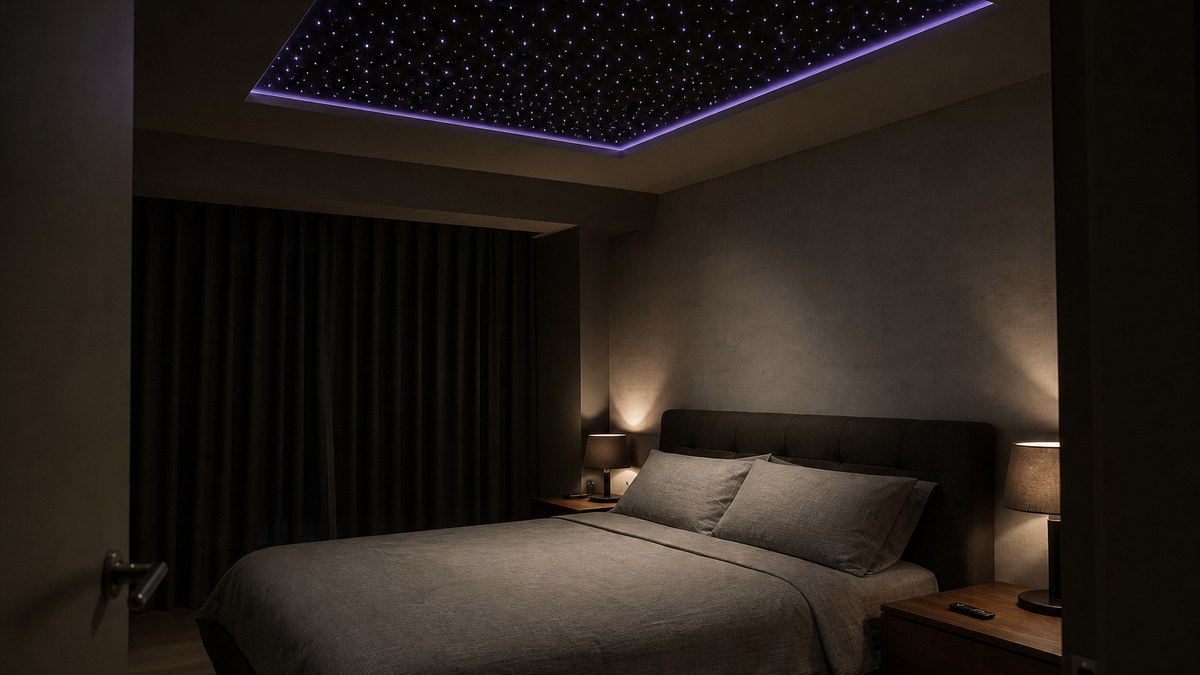
Low heat, no current at the ceiling, and smooth dimming make low-voltage fiber panels a natural fit over a bed or crib. A wall control or RF remote keeps things simple. Get layout ideas on our starlight ceiling for bedroom page.
Home theaters and media rooms
Acoustic star panels absorb echo with NRC 1.0+ options while the power supply tucks into the AV rack for "movie mode" control. Learn more on our home theater starlight ceiling page and in our acoustic star ceiling panels guide.
Basements and game rooms
Modular lay-in tiles and a power supply in the plenum make suspended ceilings one of the easiest upgrades in the house. Most basement fields go in within a day.
Outdoor living and pools
Star panels are an indoor product. For covered patios, pool areas, and water features, our partners at Premium Pool Lighting design pool and aquatic lighting that finishes the rest of the space.
Commercial Lighting Applications From Our Network
Star ceilings are often one piece of a bigger lighting plan. In Texas, our network partners handle LED lighting solutions in Dallas, Fort Worth LED lighting, LED lighting in Plano, commercial LED lighting in Arlington, and Irving LED lighting services, plus Texas-wide LED lighting and wholesale LED solutions for larger projects.
Building a new theater room, studio, or office? Modular building solutions and modular structures in Dallas can deliver the space — and we'll finish it with a low-voltage star ceiling. You can also find the cities we serve nationwide on our locations page.
Frequently Asked Questions About Low Voltage Star Ceiling Panels
What are low voltage star ceiling panels?
Low voltage star ceiling panels are pre-wired panels whose fiber optic stars are lit by an LED light engine running on low-voltage DC power. A plug-in power supply converts household power, and the panels link together with Cat5 cable from one standard outlet.
Do star ceiling panels need an electrician?
Usually not. Low voltage star panels plug into a standard outlet through a power supply. An electrician is only needed if there is no outlet where the power supply will sit, which is the most common cause of install-day delays.
Are LED star ceiling panels the same as fiber optic panels?
Not always. Some LED star panels use LED chips on the face, which look like dots and put current at every star. Fiber optic panels use one LED light engine and fiber strands, so the stars are pinpoints of light with no electricity or heat at the ceiling.
How much electricity does a star ceiling use?
A typical residential star ceiling field draws about 10 to 30 watts. A 20 watt system running four hours a night uses about 29 kWh per year, which is only a few dollars of electricity.
Are star ceiling panels dimmable?
Yes. Quality panels include white starlight with dimming in the base price of about $55 per square foot. Twinkle, shooting stars, RGB color and smart control are custom add-ons with extra cost.
Can I control a star ceiling with a remote or my phone?
Yes. RF remotes and wall controls work with hidden light engines, while IR remotes need line of sight and often fail when the engine is hidden. App, Wi-Fi and voice control are available as a smart home add-on, typically $500 to $1,500 or more.
What are modular star ceiling panels?
Modular star ceiling panels are standard-size pre-wired units, usually 2x2 or 2x4 feet, that fit together to build a star field. A 2x2 panel costs about $220 and a 2x4 about $440, and you can expand the field or replace one panel later.
How much do low voltage star ceiling panels cost installed?
Installed cost is about $77 per square foot, made up of about $55 per square foot for panels and about $22 per square foot for installation. A 10x10 room is about $7,700 and a 12x12 field is about $11,088 before add-ons.
Are low voltage star ceilings safe for bedrooms and nurseries?
Yes. Fiber optic stars carry only light, so there is no electricity or heat at the ceiling face, and the system runs on power-limited low-voltage circuits. Keep the power supply accessible and ventilated.
How long do low voltage star ceiling panels last?
Quality PMMA fibers stay clear for 20 or more years and the LED light engine is rated for 50,000 or more hours. Our panels include a 2-year product warranty, and professional installation includes a lifetime workmanship warranty.
Ready for a Safe, Simple, Low Voltage Night Sky?
Tell us your room size, ceiling type, and outlet location. We'll design a modular fiber optic star field with the right controls, then send a clear quote with product and installation priced separately. Every panel carries a 2-year product warranty, and every professional install includes a lifetime workmanship warranty.
(702) 738-2218 Get Your Free Quote →