
Star Ceiling Without Attic Access: 2026 Guide to No-Drill, No-Drywall-Removal Options That Actually Work
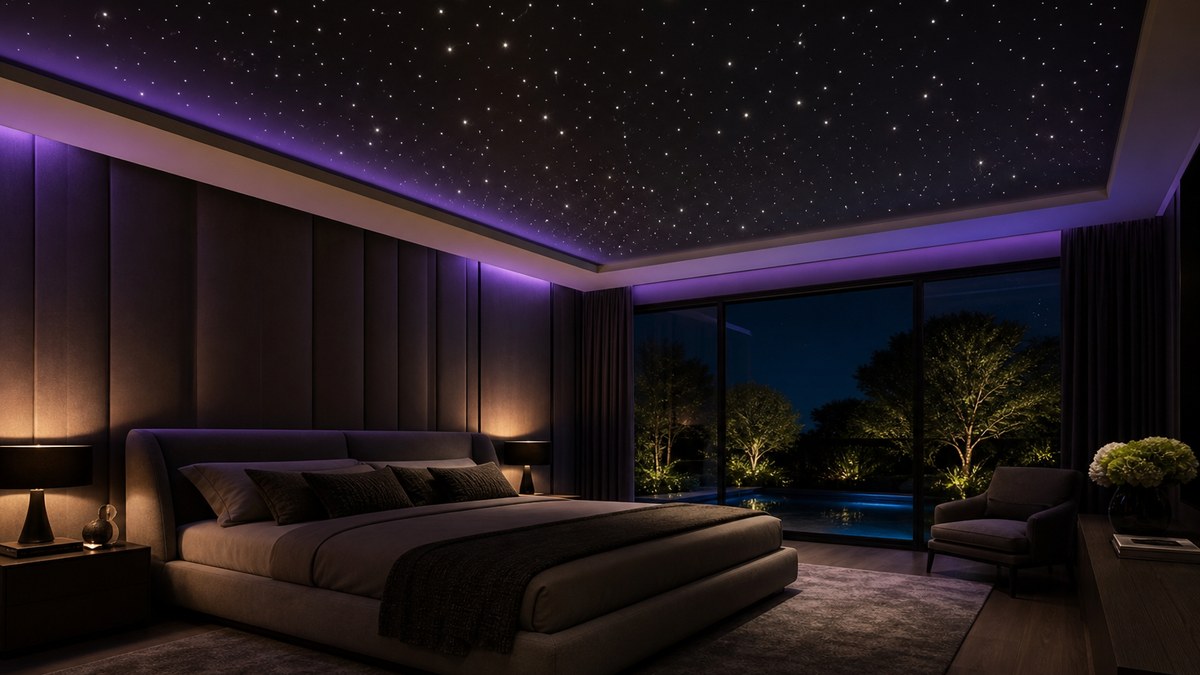
Yes, you can get a star ceiling without attic access. The trick is to stop threading fibers through the ceiling and mount premade fiber optic star panels to the ceiling you already have. The stars, fibers, and LED light engine come built into each panel, so nothing goes above the drywall, nothing gets drilled star by star, and no drywall comes down. In 2026 that costs about $55 per square foot for panels or about $77 per square foot installed.
Most star ceiling tutorials assume you can crawl into an attic and push hundreds of fiber strands down through tiny holes. That works for a top-floor room with an open attic. It falls apart in a condo, a first-floor room under a bedroom, a finished basement with drywall, or a vaulted ceiling with no space above it. At American Starlight Ceilings, these "no access" rooms are some of the most common projects we see.
This guide walks through every real option for a ceiling you can't get above: surface-mounted panels, drop ceiling tiles, soffits and tray build-downs, and the shortcuts that don't hold up. You'll see which one fits your room, what the install day looks like, and what each option costs for real room sizes.
✦ Quick Answer: How Do You Get a Star Ceiling Without Attic Access?
Mount premade star panels below the ceiling instead of threading fibers through it. The key numbers for 2026:
- Best option for most rooms: surface-mounted fiber optic star panels fastened to the existing ceiling and joists
- No drilling star holes, no attic, no drywall removal: fibers and the LED engine are built into each panel
- Power: one standard outlet, a plug-in supply, and a low-voltage Cat5 link between panels
- Drop ceilings: lay-in 2x2 or 2x4 star tiles swap in for standard tiles with about 3–4 in of clearance
- Cost: about $55/sq ft for panels or about $77/sq ft installed — around $7,700 for a 10x10 room
- Install time: most rooms take 1–2 days; a 2-person crew covers about 75–90 sq ft per day
- Warranty: 2-year product warranty plus a lifetime workmanship warranty on professional installs
Why Most Star Ceilings Need Attic Access (and Why Yours Doesn't Have To)
A traditional hand-built star ceiling works from above. You drill hundreds of small holes, push a fiber strand down through each one, and run every strand back to a light engine hidden in the attic or ceiling cavity. A 10x10 room at 7–11 stars per square foot means roughly 700 to 1,100 strands. Every one of them has to be routed, secured, and trimmed.
Without attic access, that method has no path. There's nowhere to put the light engine, nowhere to route the fiber bundle, and no way to reach the back of the drywall. That's why so many people search for a star ceiling without drywall removal — the only way to hand-drill a closed ceiling is to open it up, thread the fibers, and patch and paint afterward.
Rooms that usually have no attic access
- First-floor rooms with a bedroom or bathroom directly above
- Condos and apartments, where the space above belongs to a neighbor or the HOA
- Finished basements with a drywall ceiling under the main floor
- Vaulted, cathedral, or flat roofs with insulation packed tight against the roof deck
- Rooms under a bonus room or loft, common in newer two-story homes
The fix: move everything below the ceiling
Premade starlight ceiling panels flip the design. The fibers are already set into the panel face, and the light engine is built into the panel system. The panel mounts to your existing ceiling like a finished surface, so the drywall above it stays exactly where it is. For a deeper look at how these panels are powered, see our low voltage star ceiling panels guide.
Plain-English summary: Hand-drilled star ceilings work from above, so they need an attic. Premade panels work from below, so they don't. If you can't get above your ceiling, panels are the cleanest path to real fiber optic stars.
5 Ways to Get a Star Ceiling Without Attic Access
Here's every option we see homeowners consider, ranked from most to least practical for a closed ceiling.
| Option | Attic needed? | Drywall removal? | Look | Best for |
|---|---|---|---|---|
| Surface-mounted fiber optic star panels | No | No | Real pinpoint stars, 7–11/sq ft | Bedrooms, theaters, condos, first floors |
| Lay-in star tiles (drop ceiling) | No | No | Real fiber stars in the grid | Basements, offices, game rooms |
| Soffit, tray, or false-ceiling build-down | No | No | Recessed star field with a framed edge | Theaters, primary suites, remodels |
| Open-and-patch hand-drilled build | No (ceiling is opened) | Yes, sections | Real stars, density varies | Gut remodels where drywall is coming down anyway |
| Star projector or glow paint | No | No | Blurry dots or faint glow | Kids' rooms on a tight budget |
1. Surface-mounted star panels (best for most rooms)
This is the option we install most often in rooms without attic access. Panels fasten to the existing ceiling and into the joists from below. They link together with low-voltage Cat5 cable, and the whole field runs from one standard outlet through a plug-in power supply. You get a true fiber optic sky with mixed star sizes, white starlight, and dimming — without opening a single hole for a star.
Panels are modular. A 2x2 panel runs about $220 and a 2x4 about $440 at roughly $55 per square foot, so you can cover the whole ceiling or just a center field. Our star ceiling panels price guide breaks down panel counts by room.
2. Lay-in star tiles for drop ceilings
If your basement or office already has a suspended grid, you're in luck. Star ceiling tiles drop into the T-bar grid in place of standard tiles. You need about 3–4 inches of clearance above the grid and an outlet within reach of the power supply. There's no drilling and nothing to patch. Our star ceiling tiles for drop ceilings guide covers grid sizes, tee widths, and fit checks.
3. Soffit, tray, or false-ceiling build-down
Some clients want a recessed look — a framed "window" to the sky with a border around it. In that case, a contractor builds a shallow soffit or false ceiling a few inches below the existing one, and the star panels sit inside it. The cavity hides the power supply and cabling, and you can add cove lighting around the edge. Framing and drywall for the build-down are priced by your contractor; we quote the star field. Our custom starlight ceiling design team can plan the layout so the framing and panels line up.
4. Open-and-patch hand-drilled build
You can cut access panels or remove strips of drywall, thread fibers, then patch, tape, mud, and paint. It works, but it's slow and messy, and it's rarely cheaper once you add the drywall repair. It makes sense mostly when the ceiling is coming down anyway during a gut remodel. Our DIY star ceiling cost guide compares hand-drilled builds with premade panels line by line.
5. Projectors and glow-in-the-dark stars
Galaxy projectors and glow paint need no access at all, but they're a different product. Projectors throw soft, blurry dots and need a clear line from the device to the ceiling. Glow stars fade within minutes. Neither gives you the crisp pinpoints of fiber optic stars. They're fine for a temporary kids' room, not for a permanent feature.
How a No-Attic Star Ceiling Install Works, Step by Step
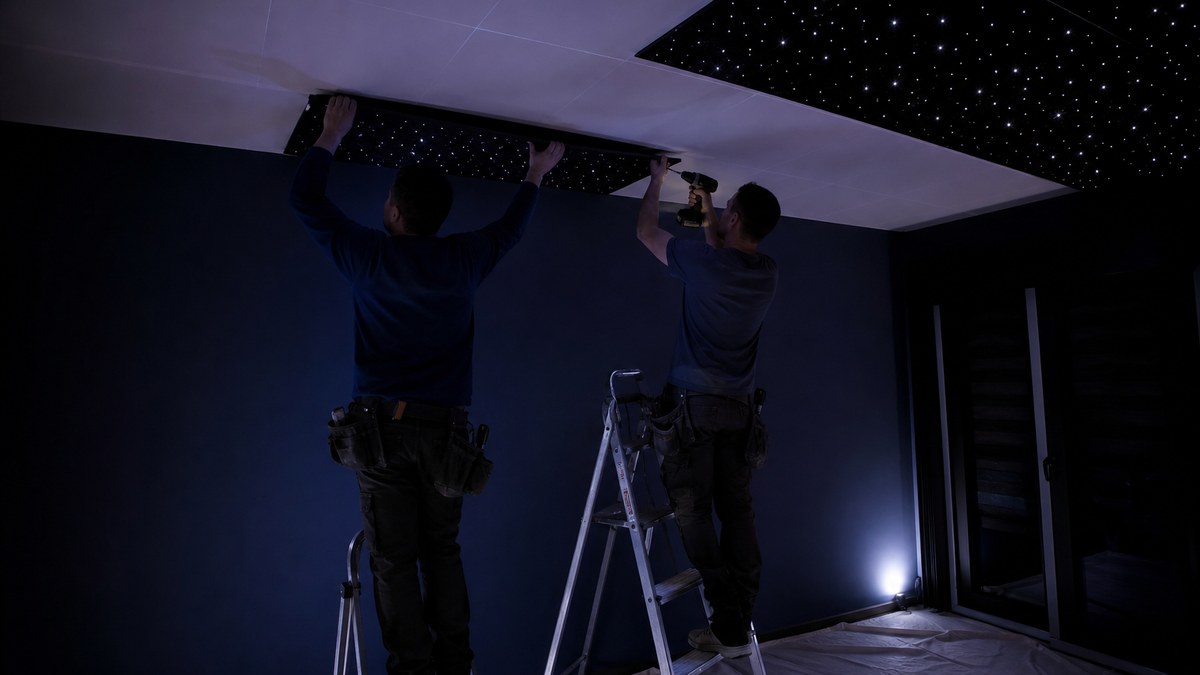
Here's what a professional surface-mount install looks like in a room with a closed ceiling. Our full starlight ceiling installation guide goes deeper on each step.
- Site check: we measure the ceiling, note joist direction, and map recessed lights, vents, smoke detectors, speakers, and fans.
- Power plan: we find an outlet for the plug-in power supply — inside a closet, a cabinet, a soffit, or near the ceiling line. This is the step that replaces "attic access."
- Layout: chalk lines mark a center reference, usually with an 8–10 inch border around the field so the edges look intentional.
- Mounting: panels go up from the center outward, fastened into joists from below. Nothing goes through to the space above.
- Linking: panels connect with low-voltage Cat5 cable in a daisy chain, routed along the panel backs or through a small chase to the supply.
- Finish: edges are trimmed and cutouts are made for fixtures where the layout calls for them.
- Power test: we check every panel, dimming, and controls, then walk you through the system.
Where does the light engine go without an attic?
This is the question we hear most. With premade panels, the light engine is part of the panel system, so it doesn't need an attic. The only component that needs a home is the plug-in power supply, which is small and sits near an outlet. Common spots include a closet next to the room, a built-in cabinet, a TV wall, an AV rack in a theater, or the cavity of a soffit. It should be ventilated and reachable for service.
Getting power to the ceiling without opening walls
Because the system is low voltage, the cable from the supply to the first panel is thin and safe to route. We can run it through a closet ceiling, along a crown molding line, inside a small paintable raceway, or behind a soffit. If there's no outlet anywhere nearby, an electrician may need to add one. That's the most common cause of install-day delays, so we flag it during the site check.
Tip: Before you request a quote, look for the closest outlet to the ceiling — especially in a closet that shares a wall with the room. Send us a photo. That one detail usually decides how clean your no-attic install will be.
No Attic? No Problem.
Send us your room size, ceiling type, and a photo of the nearest outlet. We'll design a star field that mounts below your ceiling and send a clear quote with product and installation priced separately.
(702) 738-2218 Get Your Free Quote →No-Attic Star Ceilings by Room Type
First-floor bedrooms and primary suites
A bedroom under another bedroom is the classic no-access room. Surface-mounted panels over the bed are the most popular layout — often a 4x8 or 8x8 center field rather than wall-to-wall coverage. The power supply usually lives in the closet. For layout ideas, see our starlight ceiling for bedroom page.
Condos and apartments
Condo owners can't drill into shared space, and many HOAs restrict ceiling penetrations. Panels attach from below and stay inside your unit. Check your HOA rules on fastening into the ceiling, and keep the documentation from your quote handy for the board. Renters should get landlord approval before any ceiling work.
Finished basements
Drywall basement ceilings work the same as any closed ceiling: panels mount from below. If the basement has a drop ceiling, lay-in star tiles are the easiest win. Either way, plan around ducts, beams, and soffits that already run through the space.
Home theaters and media rooms
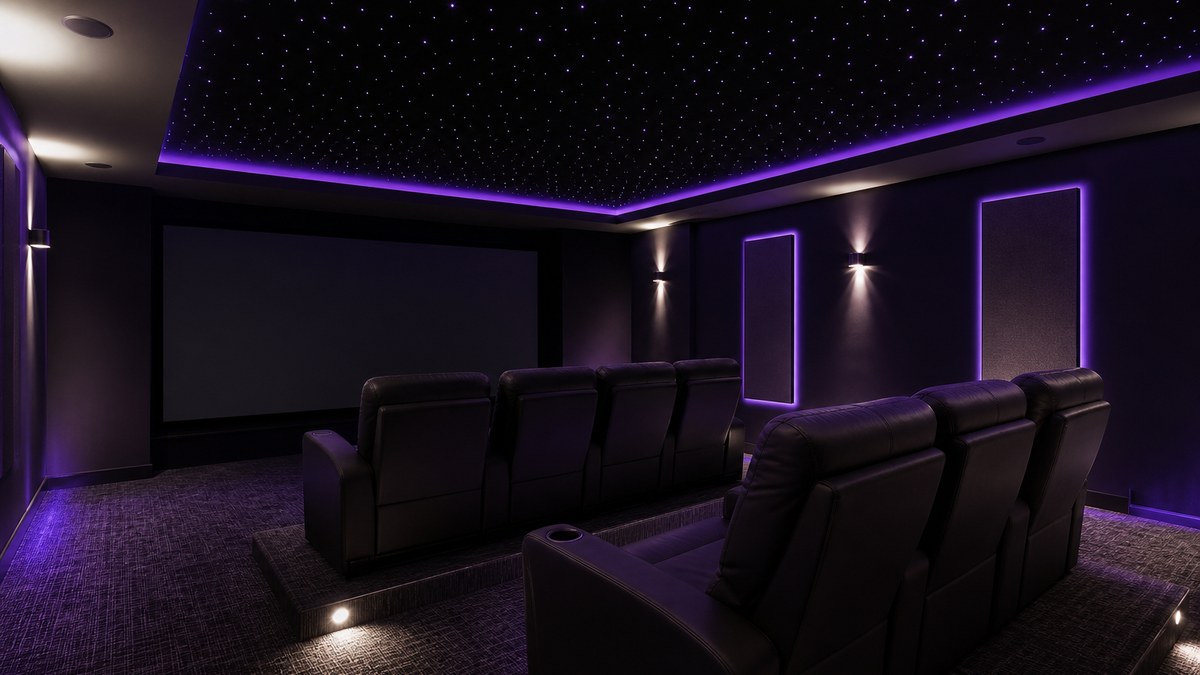
Many dedicated theaters sit in basements or between floors, so attic access is rare. Acoustic star panels mount to the existing ceiling and absorb first reflections at the same time. Stop the field 2–3 feet before the screen and keep Atmos speakers in the border. Our acoustic star ceiling panels guide and home theater star ceiling cost guide cover both.
Vaulted and sloped ceilings
A vaulted ceiling with no attic above is a strong case for panels. Panels follow the slope in rows, and the field can stop at a ridge or beam for a clean edge. Steep or very tall ceilings need lift equipment, which adds to the labor quote.
How Much Does a Star Ceiling Without Attic Access Cost?
Here's the good news: skipping the attic doesn't add a premium. Premade panels cost the same whether you have attic access or not, because nothing is routed above the ceiling. Pricing is about $55 per square foot for panels and about $22 per square foot for installation, so about $77 per square foot installed. These are guide ranges; your quote depends on room size, layout, ceiling height, and effects.
| Layout | Area | DIY panels (~$55/sq ft) | Installed (~$77/sq ft) |
|---|---|---|---|
| 4x8 feature over a bed | 32 sq ft | ~$1,760 | ~$2,464 |
| 8x8 center field | 64 sq ft | ~$3,520 | ~$4,928 |
| 10x10 bedroom, full ceiling | 100 sq ft | ~$5,500 | ~$7,700 |
| 12x12 primary suite, full ceiling | 144 sq ft | ~$7,920 | ~$11,088 |
| 12x15 media room, full ceiling | 180 sq ft | ~$9,900 | ~$13,860 |
What's included in the base price
- Fiber optic stars at about 7–11 stars per square foot, in mixed sizes
- The built-in LED light engine and low-voltage power supply
- White starlight with dimming
- Cat5 panel linking from one standard outlet
Custom effects are extra-cost add-ons
Twinkling, shooting stars, color changing, and constellation layouts are custom add-ons with extra cost. They are never included in base panel pricing. Typical ranges: twinkle $300–1,000+, shooting stars $500–2,000+, RGB or RGBW color $500–2,000+, smart app and voice control $500–1,500+, and constellation mapping $1,000–3,000+. Plan them before install. See our custom star ceiling cost guide and color changing star ceiling guide for details.
Costs that sit outside our quote
- New outlet: if none is available, an electrician adds one
- Soffit or false ceiling framing: priced by your contractor if you want a recessed look
- Lift equipment: for very tall vaulted ceilings
Compare this to opening the ceiling for a hand-drilled build: the fiber kit, light engine, and dozens of hours of threading, plus drywall cutting, patching, mudding, sanding, and repainting. For most closed ceilings, panels end up cleaner and close in price. Our starlight ceiling cost guide has the full breakdown.
Can You DIY a Star Ceiling Without Attic Access?
Yes, if you're comfortable on a ladder and can find joists. Premade panels are built for it: you mount them from below, link them with Cat5, and plug in. Most DIYers finish a bedroom in a weekend. Our DIY starlight ceiling kits page shows what ships in the box.
Go with professional starlight ceiling installation if the ceiling is over 10 feet, vaulted, full of fixtures, or part of a theater with speakers and a projector. A pro install also adds a lifetime workmanship warranty on top of the 2-year product warranty. If you want to compare local crews, our star ceiling installer guide lists the questions to ask.
| Factor | DIY panels | Professional install |
|---|---|---|
| Cost | ~$55/sq ft | ~$77/sq ft |
| Time | A weekend for most bedrooms | 1–2 days for most rooms |
| Tools | Ladder, stud finder, drill, chalk line | Handled by the crew |
| Warranty | 2-year product | 2-year product + lifetime workmanship |
| Best for | Flat ceilings under 9–10 ft | Vaulted, tall, theater, or complex layouts |
Common Mistakes With No-Attic Star Ceilings
- Opening the ceiling first: people cut drywall before realizing panels would have avoided it entirely.
- Forgetting the outlet: no outlet near the supply location is the #1 reason install day slips.
- Ignoring fixtures: recessed lights, vents, and detectors need to be mapped so the layout works around them.
- Buying LED-chip panels: some "no drill" panels use LED dots on the face, which look like plastic pinholes, not stars.
- Adding effects later: twinkle and color depend on the light engine, so choose them before install.
- Skipping the HOA check: condo owners should confirm ceiling fastening rules first.
Commercial Lighting Applications From Our Network
Closed ceilings show up in commercial spaces too — hotel suites, lounges, and offices with occupied floors above. Our commercial star ceiling guide covers code and plenum details. For larger custom builds, fiber optic lighting solutions from 360 Fiber Lighting handle facades and outdoor features, and pool and aquatic lighting can finish a backyard project.
In Texas, our network partners handle LED lighting solutions in Dallas, Fort Worth LED lighting, LED lighting in Plano, commercial LED lighting in Arlington, and Irving LED lighting services, plus Texas-wide LED lighting and wholesale LED solutions for larger projects.
Adding a new theater room, studio, or office? Modular building solutions and modular structures in Dallas can deliver the space, and we'll finish it with a star ceiling. Browse finished rooms in our gallery or see the cities we serve on our locations page.
Frequently Asked Questions About Star Ceilings Without Attic Access
Can you install a star ceiling without attic access?
Yes. Premade fiber optic star panels mount to the existing ceiling from below, with the fibers and LED light engine built into the panel system. Nothing has to be routed through the attic, and no drywall comes down.
How do you put fiber optic stars in a ceiling without drilling holes?
Use premade star panels or drop ceiling star tiles. The stars are already set into the panel face, so you only fasten the panels into the joists and link them with low-voltage Cat5 cable. No individual star holes are drilled into your ceiling.
Do I need to remove drywall for a star ceiling?
No. Drywall removal is only needed for hand-drilled builds in a closed ceiling. Surface-mounted panels attach over the existing drywall, so there is no cutting, patching, or repainting.
Where does the light engine go if there is no attic?
With premade panels, the light engine is part of the panel system. Only the small plug-in power supply needs a spot near an outlet, such as a closet, cabinet, soffit, or AV rack, where it stays ventilated and easy to reach.
How much does a star ceiling without attic access cost?
About $55 per square foot for panels or about $77 per square foot installed. A 4x8 feature is about $2,464 installed, a 10x10 room about $7,700, and a 12x12 room about $11,088. Twinkle, shooting stars, color, and smart control are extra-cost add-ons.
Can I get a star ceiling in a condo or apartment?
Usually yes. Panels mount from below and stay inside your unit, so nothing enters shared space. Check your HOA rules on ceiling fasteners first, and renters should get landlord approval.
Does a no-attic star ceiling need an electrician?
Usually not. The system plugs into a standard outlet through a low-voltage power supply. You only need an electrician if there is no outlet where the power supply will sit.
Can star panels go on a vaulted ceiling?
Yes. Panels follow the slope in rows and can stop at a ridge or beam for a clean edge. Very tall vaulted ceilings may need lift equipment, which adds to the installation quote.
How long does a star ceiling without attic access take to install?
Most rooms take one to two days. A two-person crew installs about 75 to 90 square feet per day, so a 4x8 feature can be done in half a day and a 12x15 media room in two to three days.
What warranty comes with a no-attic star ceiling?
Our panels carry a 2-year product warranty, and professional installs include a lifetime workmanship warranty. The fibers stay clear for 20 or more years and the LED engines are rated for 50,000 or more hours.
Ready for Real Stars Without Opening Your Ceiling?
Tell us your room size, ceiling type, and outlet location. We'll design a fiber optic star field that mounts below your ceiling — no attic, no drilled star holes, no drywall removal. Every panel carries a 2-year product warranty, and every professional install includes a lifetime workmanship warranty.
(702) 738-2218 Get Your Free Quote →